Thermal Imaging Cameras
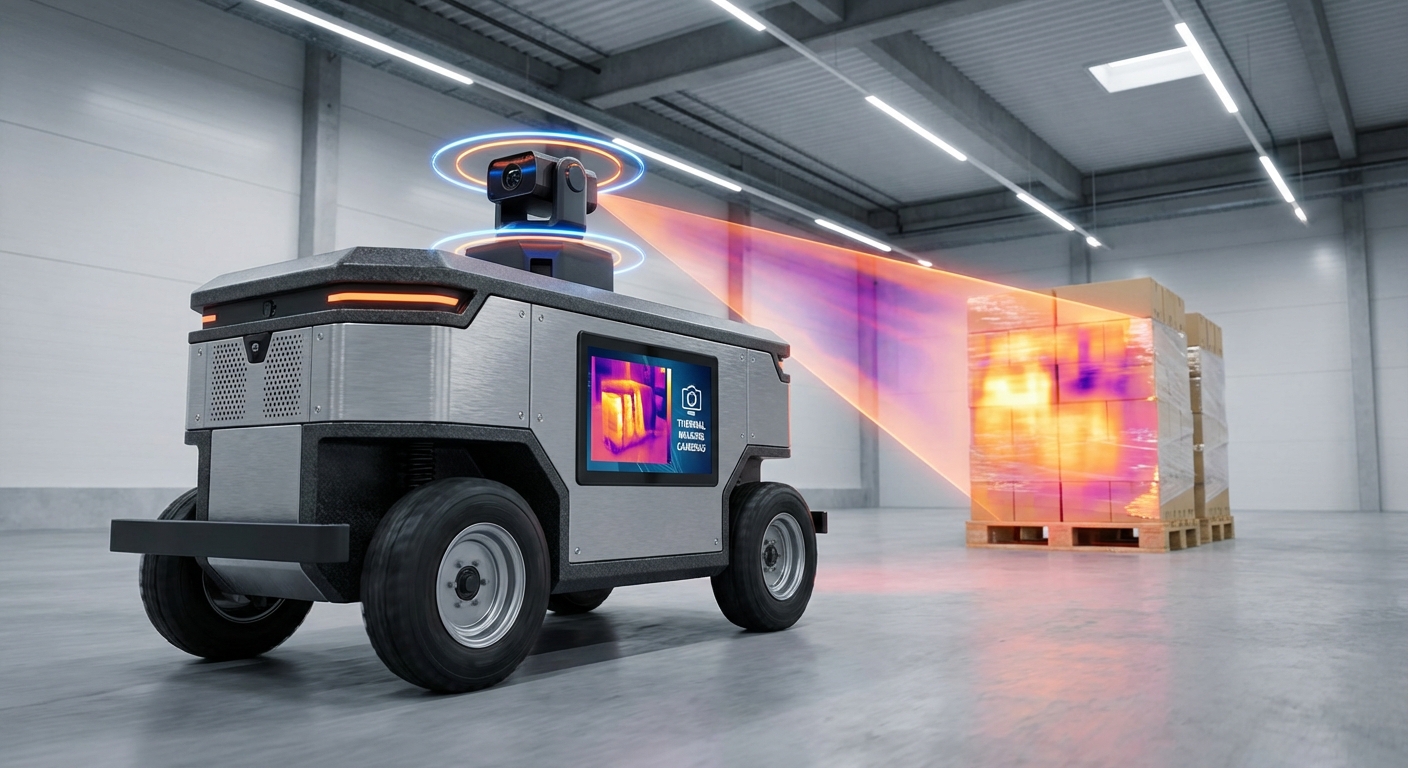
Unlock the power for your AGVs to cruise through total darkness and handle predictive maintenance on the go. Thermal imaging picks up infrared heat signatures, giving robots vision where regular RGB cameras just can't hack it.
Core Concepts
Infrared Radiation
Thermal cameras spot radiation in the long-wave infrared (LWIR) range (8–14 µm). Unlike visible light, this lets robots "see" heat pouring off objects, no matter the lighting.
Microbolometers
The go-to tech in most uncooled mobile robot cameras. These grids of tiny vanadium oxide or amorphous silicon resistors shift their resistance when IR radiation warms them up.
Emissivity
A key factor in how well a surface gives off heat. Robots have to factor in emissivity differences—like shiny metal versus matte wood—to nail accurate temperature readings.
Radiometry
Radiometric thermal cameras deliver real temperature values for every pixel, turning the image into a packed grid of data points ready for analysis.
Sensor Fusion
The trick of layering thermal data over RGB video or LiDAR maps. It gives context, so you spot "what" something is (from RGB) and "how hot" it runs (from thermal) all at once.
Automatic Gain Control
Smart algorithms that tweak thermal image contrast on the fly based on the scene's temp range, helping robots pick out targets whether it's a chilly 10°C or a scorching 100°C.
How It Works
Thermal imaging cameras work on a whole different principle from regular ones. They don't grab reflected visible light photons—they catch infrared energy emitted by objects. Anything above absolute zero gives off this heat radiation.
The lens funnels that infrared energy onto a Focal Plane Array (FPA) of detectors. Those elements warm up based on the energy hitting them, altering their electrical resistance. A readout circuit measures the shift and turns it into a digital signal.
For mobile robots, an onboard processor maps those signals to colors or grayscale, whipping up a "thermogram." Hotter spots glow brighter or redder, letting the robot's vision system pick out warm humans or overheating gear against a cool backdrop.

Real-World Applications
Automated Inspections
AGVs with radiometric thermal cameras roam server farms or electrical substations, spotting overheated breakers, cables, or racks before trouble hits—logging the exact temp spikes.
Safety & Human Detection
In warehouses with tricky lighting, shadows, steam, or fog, regular cameras flop at spotting people. Thermal cams nail the human heat signature, triggering safety stops even in total blackout.
Fire Prevention
Waste management or chemical storage robots use thermal imaging to catch "hot spots" in material piles—jumping in hours before a fire sparks or smoke alarms blare.
Outdoor Navigation
For last-mile delivery bots or ag UGVs, thermal cams slice through camouflage. They spot animals in tall grass or guide night paths without guzzling power on headlights.
Frequently Asked Questions
Can thermal cameras see through glass?
Generally, no. Regular glass bounces long-wave infrared like crazy. Point a thermal cam at a window, and you'll probably see your own reflection or the room's heat, not outside. Thermal lenses are usually germanium.
What is the difference between thermal imaging and active night vision?
Active night vision pairs a regular camera with an IR spotlight to illuminate things. Thermal is passive—no light needed since it detects heat straight from objects. Thermal crushes it for long-range spotting of people or hot machines.
What resolution is typical for an AGV thermal camera?
Thermal sensors pack way lower resolutions than optical cams due to cost and size. Robotics sweet spots run 160x120 to 640x512 pixels—320x240 hits the mark for most obstacle dodging and hotspot hunting.
How does thermal imaging integrate with ROS (Robot Operating System)?
Big-name thermal cam makers like FLIR or Optris offer ROS drivers. These nodes pump out image topics (usually as `sensor_msgs/Image`) with 16-bit raw temps or 8-bit visuals, ready for OpenCV or nav stacks to crunch.
Can thermal cameras affect AGV battery life?
Modern uncooled microbolometer cams sip power at 1W to 2.5W. No biggie for hefty AGV forklifts, but small drones or battery-limited inspectors need to budget it carefully.
Why are there frame rate restrictions (9Hz vs 60Hz)?
Thanks to export rules (like US ITAR), thermal cams over 9Hz frame rates are restricted. Slow AGVs do fine at 9Hz, but speed demons might need "fast video" licenses for 30Hz or 60Hz smooth sailing.
Can thermal imaging be used for SLAM (Simultaneous Localization and Mapping)?
Yep, thermal SLAM works but it's tough. Thermal pics often lack sharp edges or texture (especially in even-temp spots), making feature matching tricky. It shines when fused with LiDAR or visual SLAM for reliability.
What is Non-Uniformity Correction (NUC)?
NUC is a calibration where a shutter briefly blocks the sensor to fix pixel drift. You'll hear a "click" and see a video freeze for a split second. Robot software has to manage these blips to avoid nav glitches.
Are thermal cameras effective in fog or smoke?
Yes, huge perk. Long-wave IR cuts through smoke, light fog, and dust better than visible light. That's why thermal cams are staples for emergency bots and dusty mining AGVs.
What is the cost difference compared to RGB cameras?
Thermal sensors cost a lot more. A solid industrial RGB cam might run $200-$500, but a matching thermal module? Think $1,500 to $5,000+. So they're saved for must-have jobs like night vision or heat spotting.
Does the camera need frequent calibration?
For navigation, usually no calibration needed. But for precise radiometric temp work, check it yearly against a blackbody source to keep accuracy sharp. Temps can drift over time or from harsh shocks.