Tactile and Touch Sensors
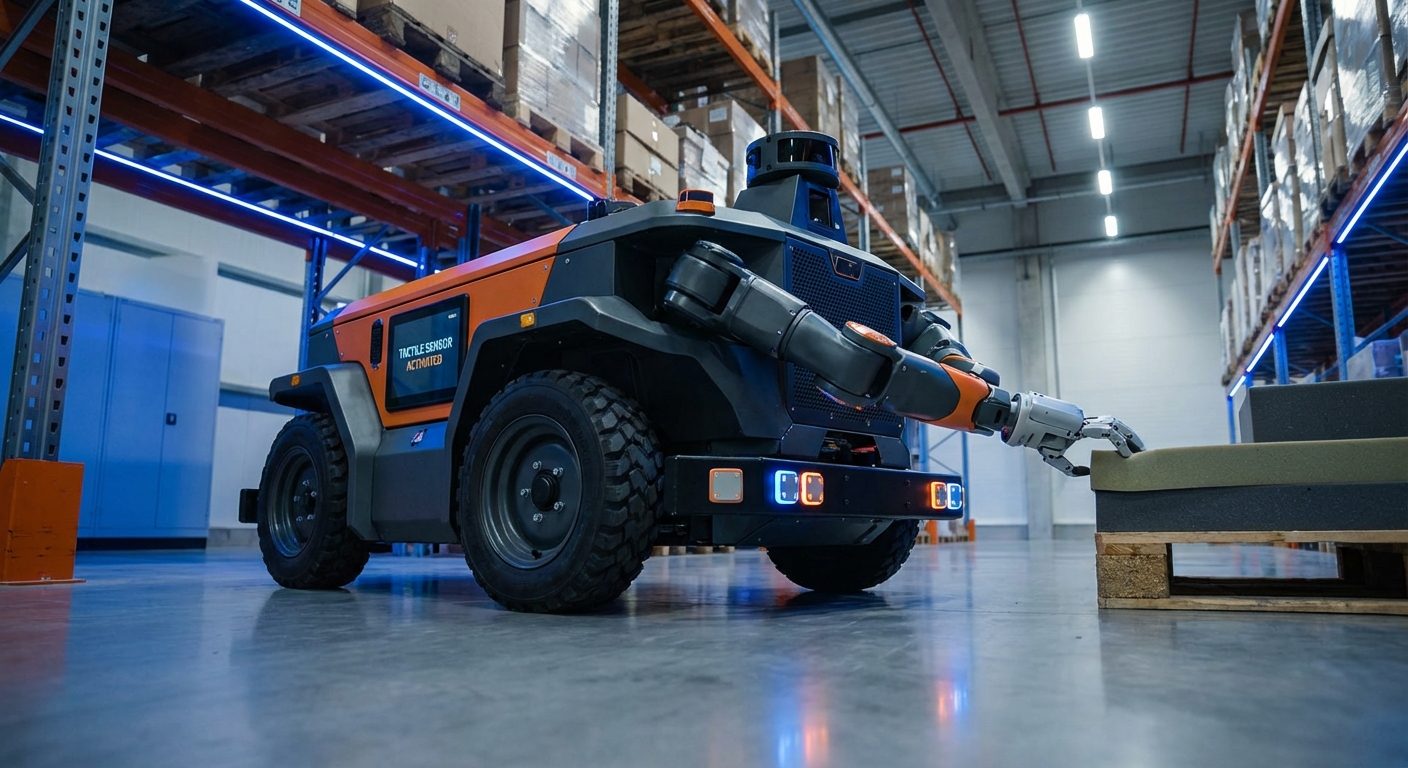
Acting as the digital 'skin' for autonomous mobile robots, tactile sensors deliver that vital final safety net and enable spot-on interaction with the real world. From emergency bumpers to gripper feedback, they let AGVs thrive in changing environments.
Core Concepts
Binary Contact
The most basic touch sensing in AGV bumpers. It works like a simple on/off switch, slamming the brakes with an emergency stop the instant it hits an obstacle.
Force Sensing Arrays
Advanced grids that sense not just contact, but pressure strength and spread. This lets robots gauge an object's weight and stiffness as they handle it.
Piezoresistive Tech
A popular method where electrical resistance shifts under mechanical strain. It's super sensitive and powers a lot of modern robotic skins.
Capacitive Sensing
Like touchscreen tech, these pick up capacitance changes. They spot proximity (almost-touch) and material traits, perfect for cobots teaming up with humans.
Slip Detection
Essential for AGVs with arms. By catching tiny vibrations at contact, the robot senses if something's slipping and tweaks grip force on the fly.
Proprioception
Not external touch, but internal joint torque sensors let the robot 'feel' resistance in motion—spotting collisions or payload weight without needing outer skin.
How It Works: The Transduction Loop
Tactile sensing relies on —the conversion of physical stimuli into electrical signals. In an AGV context, this usually begins with a mechanical deformation. When a safety bumper compresses or a gripper touches a box, the sensor material (often conductive rubber, foam, or a piezoresistive film) changes its electrical properties.
That shift in resistance or capacitance gets picked up right away by an Analog-to-Digital Converter (ADC). The raw signal gets cleaned up (noise filtered, debounced) and shipped to the robot's brain.
For safety bumpers, it's dead simple and top priority: circuit opens or closes, and motors lose power in milliseconds. For fancy grippers, it builds a 'tactile image' so the robot can fine-tune force—no crushing fragile stuff, but a firm hold.

Real-World Applications
AGV Safety Bumpers
Every standard AMR and AGV packs pressure-sensitive bumpers as the ultimate backup, triggering an E-Stop if LiDAR or cameras miss a low obstacle or a foot in a blind spot.
Delicate Material Handling
Mobile manipulators rely on high-res tactile sensors at the end-effector to grab items of different densities (like glassware or metal parts) without smashing them or dropping during transit.
Cobot Collaboration Skins
Collaborative robots sport 'electronic skin' over their body. If a worker bumps the arm by mistake, capacitive or resistive sensors catch it and pause everything to avoid injury.
Surface Quality Inspection
Specialized inspection bots use tactile probes to sweep surfaces, picking up tiny scratches, textures, or flaws that cameras might overlook due to bad lighting.
Frequently Asked Questions
What is the difference between tactile sensing and force sensing?
Tactile sensing covers contact detection over a surface (like skin), giving info on texture, shape, and pressure spread. Force sensing zeroes in on the total force and torque vector at one spot—great for weighing loads or spotting joint resistance.
Why do AGVs need touch sensors if they already use LiDAR and Cameras?
LiDAR and cameras handle non-contact nav and avoidance, but they've got blind spots (especially low to the ground) and hate funky lighting or glass. Touch sensors like bumpers add that required physical fail-safe per ISO standards—stopping dead on contact.
How fast is the response time for a safety bumper?
Safety-rated bumpers react in a flash (usually under 10-20ms). That mechanical snap is quicker than image crunching, cutting motor power the second compression hits to slash impact force.
Are tactile sensors durable enough for harsh industrial environments?
Yes, industrial tactile sensors have tough shells like reinforced rubber or polyurethane to shrug off abrasion, oil, and dust. Still, they're wear items—bumpers might need swapping after big hits or years of grind.
How does calibration work for capacitive tactile skins?
Capacitive skins need startup calibration to tune out the robot's own body and ambient noise (like EMI). The sensor controller handles it. Recalibrate if humidity swings wild or EMI ramps up.
Can tactile sensors detect the type of material being touched?
Fancy multi-modal tactile sensors can guess material types. By checking thermal conductivity (with added thermal sensors) or how it deforms under pressure, they tell metal from plastic or rubber.
Do tactile sensors require a lot of processing power?
Simple binary bumpers barely tax the processor. But high-res tactile arrays (like on a robot hand) spit out tons of data ('tactile images') needing special hardware or edge computing for real-time crunching without bogging down the main controller.
What happens if a touch sensor malfunctions?
In a safety-compliant AGV system, sensors are wired in a "fail-safe" setup. If a wire gets cut or a sensor fails, the circuit opens up, acting just like a collision. This makes the robot stop dead in its tracks and shift into an error state, so it won't budge without its safety systems fully active.
How does slip detection improve battery life?
Without slip detection, a robot gripper has to crank up to max force for a solid hold, burning through energy. Add slip detection, and it dials down to just the right amount of force needed—saving power, boosting efficiency, and sparing the gripper motors from extra wear.
Are there wireless tactile sensors for rotating parts?
Yes, but it's trickier. Putting sensors on spinning parts like wheels or 360-degree joints usually means slip rings for wired setups or wireless transmitters (Bluetooth/Zigbee) running on batteries or inductive power, which brings latency and more maintenance headaches.
What is the "Dead Zone" in tactile bumpers?
The dead zone is how much a bumper has to squash before the switch kicks in. If an AGV's hauling too fast, it could zip right through that zone and smack the chassis before stopping. That's why engineers crunch the stopping distances to make sure the bumper's deep enough for top speeds.
How expensive are tactile skins compared to optical sensors?
Standard resistive bumpers cost way less than LiDAR or depth cameras. But fancy high-res capacitive skins or "e-skins" for cobots? They're pricey, often matching vision system costs thanks to the hassle of making flexible electronics.