Buck and Boost Voltage Regulators
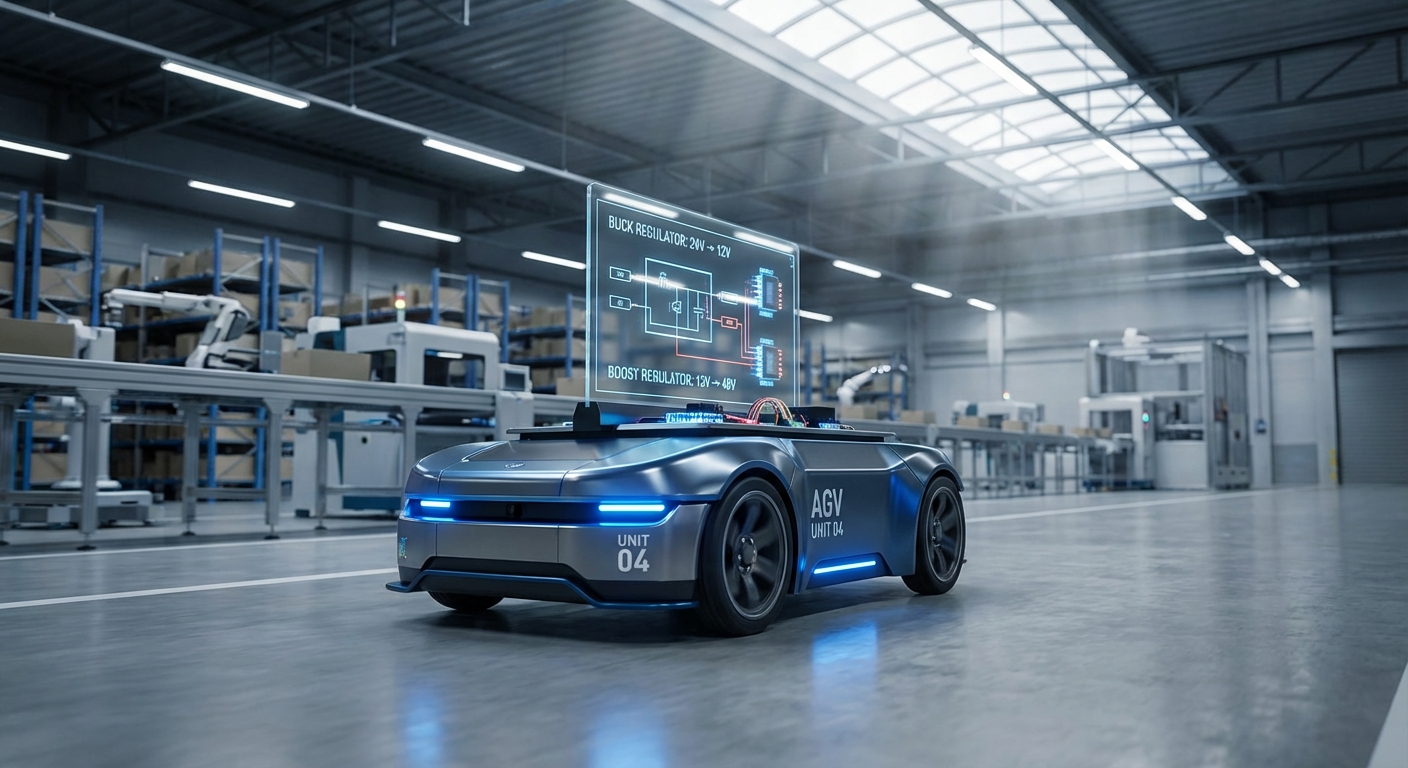
The heart of power management for autonomous mobile robots. Delivers rock-solid voltage to finicky sensors and beefy motors, boosting efficiency and runtime for your AGV fleet.
Core Concepts
Buck Conversion
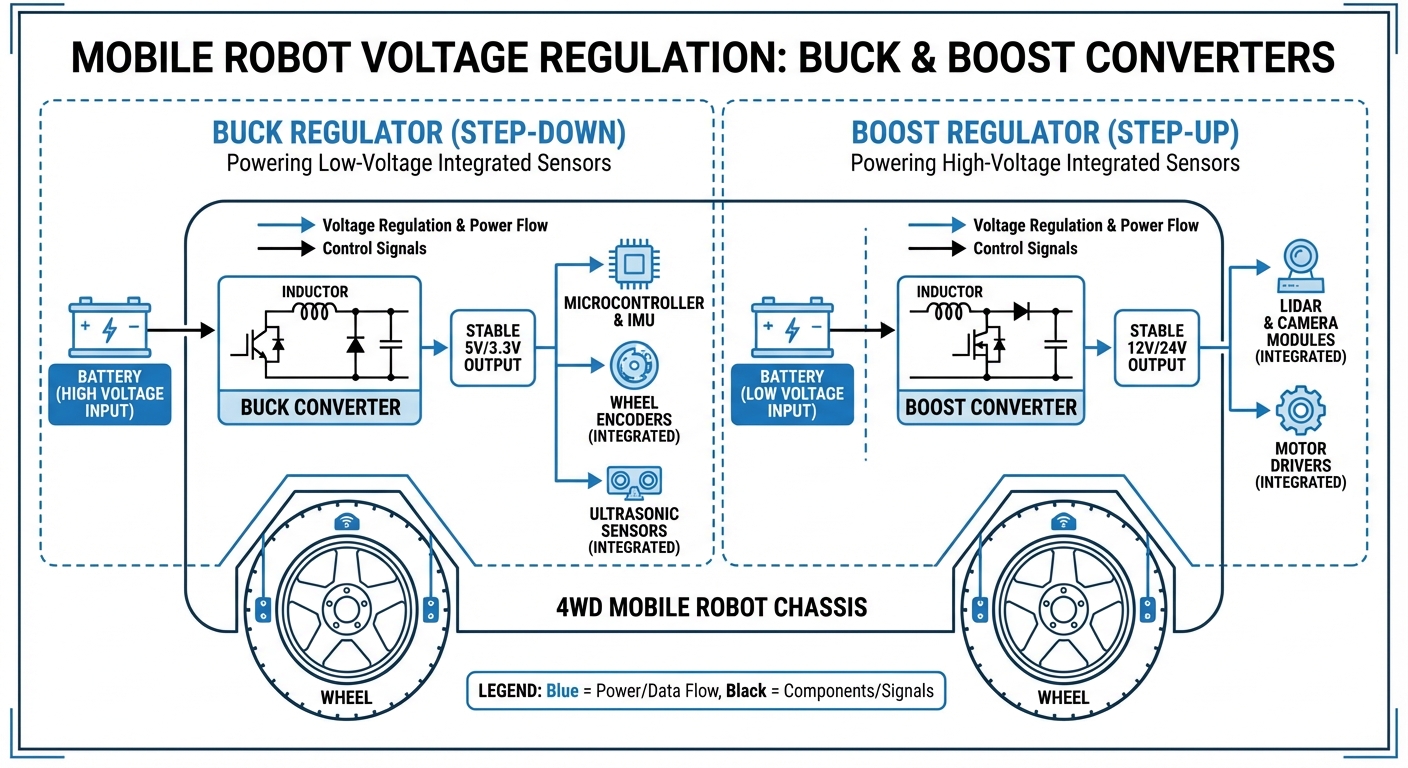
aka 'step-down' regulators. They drop battery voltage (like 48V) efficiently to safe levels for logic (5V) and MCUs (3.3V) with hardly any waste heat.
Boost Conversion
The 'step-up' boost. Key when a part like a high-torque actuator needs more voltage than the battery dishes out.
Buck-Boost Topology
It's the ultimate stabilizer. It keeps the output voltage rock-steady, no matter if the input is higher or lower – crucial for tackling battery voltage sag as your robot's charge runs down.
Switching Efficiency
Unlike linear regulators that waste extra voltage as heat, switching regulators cleverly use inductors and capacitors to transform energy at 85-95% efficiency, giving your robot way more runtime.
Output Ripple
Switching does kick up high-frequency noise, but quality regulators pack in filtering stages for "clean" power, stopping any interference with your LIDAR data or finicky IMUs.
Transient Response
AGVs face wild load swings from motors starting and stopping. A top-notch regulator snaps back instantly to current spikes, dodging voltage drops that could reboot your main computer.
How It Works: Pulse Width Modulation
Buck and Boost converters rely on a smart trick called to manage power delivery. Rather than wasting energy like a variable resistor (hello, linear regulators), a switching regulator flips a switch – typically a MOSFET – on and off thousands of times per second.
When the switch is ON, current rushes into the inductor, building energy in its magnetic field. OFF? The inductor dumps that energy to the load. Tweak the "Duty Cycle" (ON time versus OFF time ratio), and you nail precise output voltage control with barely any waste.
For modern AGVs, this setup is a must-have. Imagine a robot on a 48V Li-Ion battery smoothly powering a 12V high-power PC, 24V safety sensors, and 5V microcontrollers – all from one source, staying stable as the battery fades from 54V to 40V.
Real-World Applications
LIDAR and Vision Systems
Requirement:
Solution:
On-Board Compute (NVIDIA Jetson/IPC)
Requirement:
Solution:
Motor Drive Stages
Requirement:
Solution:
Wireless Charging Interface
Requirement:
Solution:
Frequently Asked Questions
What's the key difference between a Buck and a Boost converter?
A Buck converter steps voltage down – output lower than input, like 24V in to 12V out. A Boost does the opposite, stepping up to higher output, say 12V in to 24V out. Both rock switching tech for killer efficiency.
Why pick a Buck-Boost over a plain Buck for AGVs?
Batteries aren't steady; a '24V' pack swings from 29V full to 20V empty. Strict 24V sensors? A basic Buck quits below 24V. Buck-Boost switches modes seamlessly to lock in stable 24V no matter the battery's charge.
How does switching frequency affect regulator performance?
Higher switching frequencies (500kHz to 2MHz) mean tinier inductors and caps – less space and weight. But they can amp up heat and EMI. Lower frequencies win on efficiency, though components get bulkier.
Why is efficiency critical in robotics voltage regulation?
Efficiency rules battery life and heat control. A lousy linear regulator torches 40% as heat, needing huge heatsinks and cutting uptime. 95% efficient switching? Max runtime and sleek, fanless robot designs.
What's "Voltage Ripple" and why do sensors hate it?
Voltage ripple is that tiny AC wobble left in the DC output from switching. Too much messes with sensitive analog sensors like IMUs or ultrasonics, spitting out bad data. Robots need low-ripple supplies or extra filter caps.
How much current headroom for my regulator?
Aim for 20-30% de-rating. 7A continuous load? Grab 10A-rated. Covers heat derating, aging parts, and startup surges from inrush current.
What's Quiescent Current (Iq) and why care for robots?
Iq is what the regulator sips when idle, no load. For robots chilling in sleep mode between jobs, low Iq stops it from draining the battery dry over time.
Should I use isolated or non-isolated DC-DC converters?
Non-isolated converters are cheaper, smaller, and more efficient – perfect for most internals. Go isolated to kill ground loops (less noise) or meet safety specs for chargers or separate voltage zones.
How do I manage heat dissipation for high-power regulators?
Even 95% efficient, a 500W converter spits 25W heat. Manage it with thermal pads, chassis mounting, or airflow. Thermal shutdown protection? Non-negotiable to avoid frying components.
Can regenerative braking from motors damage voltage regulators?
Yes. Braking motors turn generators, spiking bus voltage past regulator limits. Design in braking resistors, TVS diodes, or wide-input regulators for those surges.
What if input voltage dips below the minimum?
Modern regulators have Under-Voltage Lockout (UVLO). It kills power to avoid massive current draw trying to hold output, saving the regulator and battery from deep discharge doom.
Can I parallel two regulators for double current?
Usually no, unless they're built for current sharing or poly-phase. Just wiring outputs fights them, causing chaos, noise, or burnout. Check the datasheet!