6-DOF Robotic Arms
Unlock amazing flexibility in mobile manipulation. Slap 6-DOF arms on your AGVs, and you've got real autonomous dexterity – robots that reach, grab, and handle stuff from any angle in changing spaces.
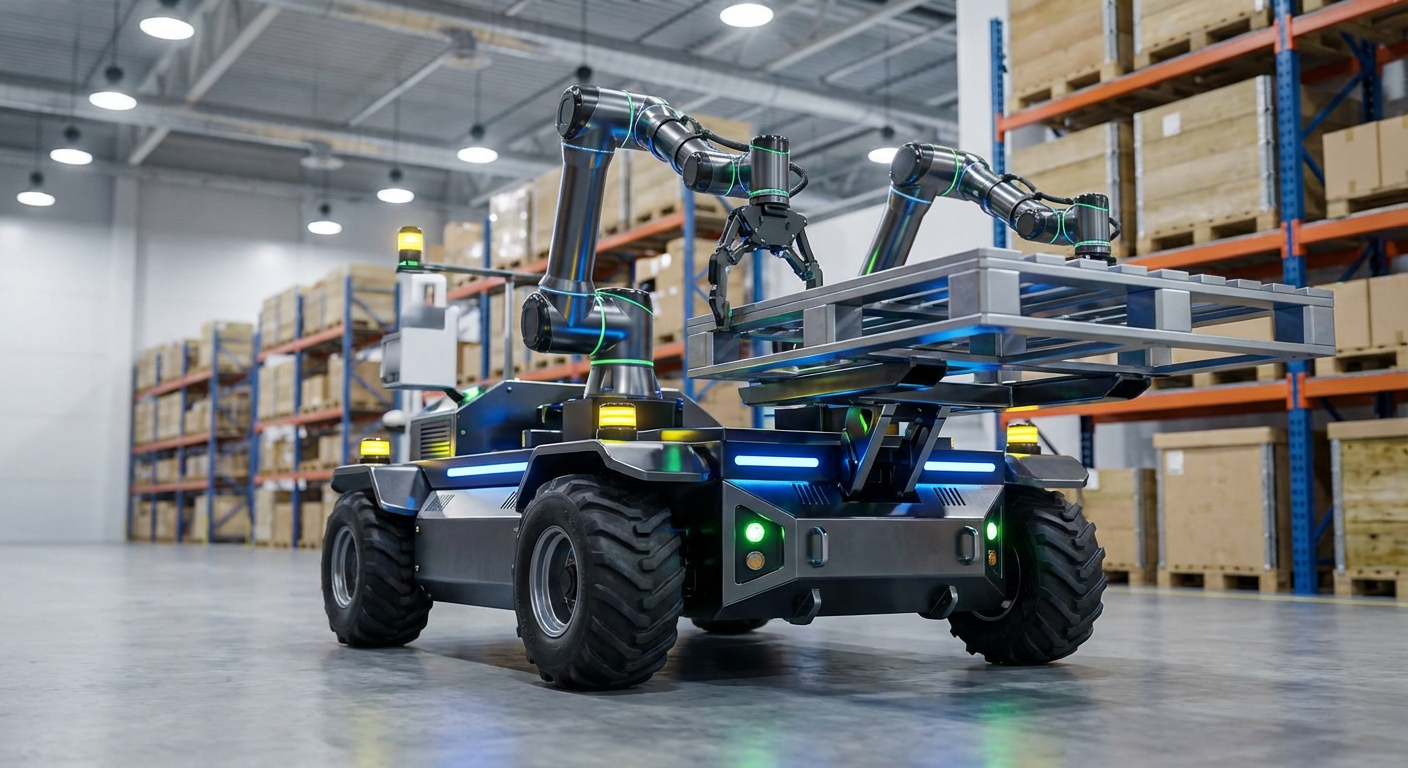
Core Concepts
Spatial Freedom (x, y, z)
The first three degrees handle position, letting the arm's end-effector hit any spot in the workspace from the mobile base.
Orientation (Roll, Pitch, Yaw)
The last three manage rotation, so the gripper can swoop in from the side, top, or any angle – just like a human wrist.
Inverse Kinematics
Clever algorithms figure out the joint angles for any target pose. For mobile manipulators, they juggle the moving base and arm together.
Payload vs. Reach
Keep the arm's reach and payload balanced to avoid tipping the AGV. Real-time center-of-gravity tracking holds it steady on the move.
Collaborative Safety
Most 6-DOF mobile arms are cobots with torque sensing. They halt on contact, so they play nice with humans sans safety fences.
End-Effectors
The 6th axis flange swaps in tools like 2-finger grippers, vacuum setups, or torches. AGVs can even tool up themselves at stations.
How It Works: The Mobile Manipulator
A 6-DOF arm has base, shoulder, elbow, and 3-axis wrist. On an AGV, the wheels add mobility degrees, making a redundant setup with endless task approaches.
The 'brain' is a unified controller syncing AGV nav (SLAM) with arm planning. Vision (LiDAR, RGB-D cams) first maps the target's 3D spot relative to the base.
This seamless link enables 'whole-body control' – the AGV tweaks its spot for optimal arm reach and leverage, nailing precision even from imperfect parking.

Real-World Applications
Semiconductor Manufacturing
Mobile manipulators shuttle FOUPs (Front Opening Unified Pods) between tools. The 6-DOF arm handles them vibration-free and aligns perfectly with cleanroom load ports.
E-Commerce Fulfillment
Beyond pallets, 6-DOF AGVs do 'each picking' – grabbing specific items of all shapes/sizes from shelves into boxes.
CNC Machine Tending
It handles automating the loading of raw materials and unloading of finished parts. The arm's flexibility lets it open machine doors, clean fixtures with air guns, and inspect parts.
Healthcare Logistics
In hospitals, these robots zip through hallways delivering medications or lab samples. The arm can press elevator buttons, open doors, and securely hand items off to nurses.
Frequently Asked Questions
What's the difference between 4-DOF and 6-DOF arms for AGVs?
A 4-DOF arm—like a SCARA or palletizer—sticks to X, Y, Z movements plus rotation around the vertical axis, keeping items flat. A 6-DOF arm adds pitch and roll, so it can tilt objects, reach from tricky angles, and tackle complex tasks like screwing in a bolt or pouring liquid.
How does the arm affect the battery life of the AGV?
Adding a robotic arm does bump up power use. The arm pulls from the joint motors and controller, but it's manageable. It usually runs off the AGV's main battery (24V or 48V DC), cutting total runtime by about 15-20% based on how often you're doing those manipulation tasks.
Does the AGV need to stop completely before the arm moves?
For super-precise tasks needing sub-millimeter accuracy, yeah, the base usually stops and brakes engage. But modern controllers support 'dynamic manipulation,' where the arm adjusts for slow base movement—great for things like scanning or spraying on the go.
What's the typical payload capacity for a mobile 6-DOF arm?
Mobile manipulators go for lightweight arms to keep the vehicle stable. Payloads usually range from 3kg to 16kg. Heavy-duty ones are out there, but they need bigger AGV bases and counterweights to avoid tipping when fully extended.
How is safety managed in shared workspaces?
Safety follows standards like ISO 10218 and ISO/TS 15066. Our 6-DOF arms are typically collaborative cobots with force-torque sensors in every joint. If it senses unexpected resistance—like a collision—it stops in milliseconds.
What is the reach of these arms?
Standard reach runs from 500mm to 1300mm. But mounted on a mobile base, the effective reach is basically infinite across the facility floor, as long as the AGV can drive there.
Do I need a vision system?
Pretty much always, yes. Fixed robots get parts in perfect jigs, but mobile ones deal with parking slip-ups. A wrist-mounted camera lets the arm 'see' the object and tweak its approach (visual servoing) for perfect pickups every time.
How complex is the programming?
Modern setups use ROS (Robot Operating System) or easy block-based graphical interfaces. Integration can be tricky, but end-user programming is often simple 'teach-and-repeat'—just guide the arm physically to record the path.
What maintenance does a 6-DOF arm require?
Maintenance is pretty low for today's electric arms. It means checking lubrication intervals (many are sealed for life), eyeing cables for wear (especially at the wrist), and recalibrating the vision if accuracy slips.
Can one arm handle multiple types of products?
Yes, with automatic tool changers. The AGV swings by a tool station, drops a finger gripper, grabs a suction cup array, and handles boxes, cylinders, or delicate electronics all in one shift.
How accurate are they compared to fixed robots?
The arm itself boasts high repeatability (+/- 0.05mm). But overall system accuracy hinges on the AGV's parking precision. That's why visual servoing with cameras closes the loop, fixing any vehicle position errors for top accuracy.
What is the ROI compared to manual labor?
Sure, the upfront cost beats a basic AGV, but ROI hits in 12-24 months. Thanks to 24/7 running, less product damage, and easy redeployment to new tasks without retooling the facility.