Research Robots Applications Industries Technology About Contact
← Back to Applications
Robot Application

Retail Shelf Scanning

Automate inventory tracking and planogram compliance with precision using autonomous mobile robots. Eliminate stockouts, ensure pricing accuracy, and empower your staff to focus on customer experience rather than manual counting.

Retail Shelf Scanning

Why Automate Retail Shelf Scanning?

Real-Time Visibility

Get instant snapshots of stock levels across thousands of SKUs, identifying low stock before shelves go empty.

Planogram Compliance

Automatically verify that products are placed according to the strategic layout plan to maximize sales potential.

Price Integrity

Detect mismatches between shelf tags and POS system prices immediately, preventing revenue loss and customer disputes.

Labor Optimization

Shift employees from tedious manual auditing to high-value customer service and merchandising tasks.

Omnichannel Accuracy

Ensure online inventory matches physical availability, reducing order cancellations for BOPIS (Buy Online, Pick-up In Store).

Data-Driven Insights

Analyze shelf trends over time to optimize restocking schedules and supplier negotiations.

Seamless Navigation &
High-Fidelity Capture

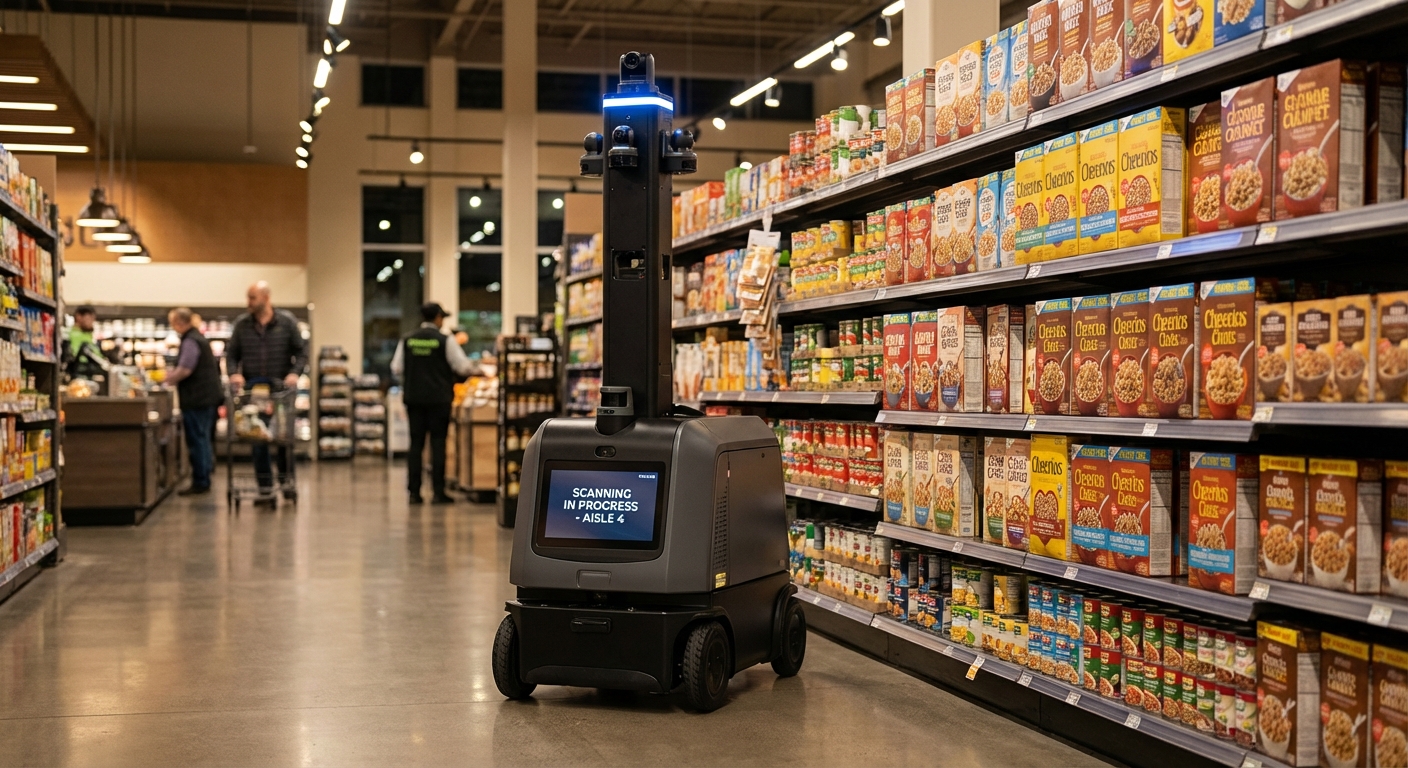
The robot utilizes advanced SLAM (Simultaneous Localization and Mapping) to navigate narrow retail aisles safely, avoiding customers and obstacles in real-time. It requires no physical infrastructure changes, such as guide wires or magnetic tape.

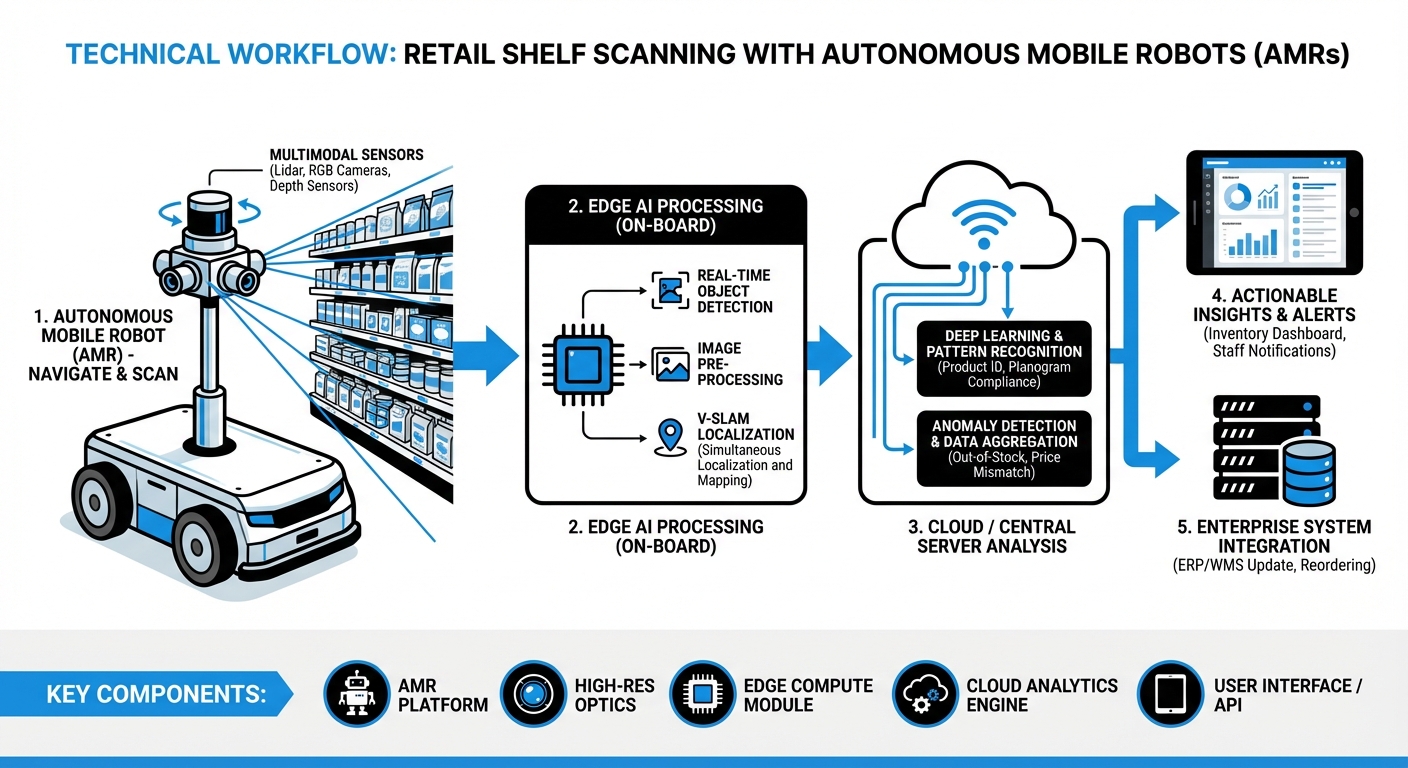
Equipped with high-resolution RGB cameras and depth sensors mounted on a vertical mast, the robot captures shelf images from top to bottom. These images are processed using Computer Vision algorithms at the edge or in the cloud.

The collected data is instantly parsed to identify product labels, detect gaps on the shelf, and read barcodes/price tags. This actionable intelligence is then pushed directly to the store's ERP or inventory management system via API.

Workflow Diagram

Where It's Used

Grocery & Supermarkets

Essential for managing high SKU turnover and perishable goods. Robots ensure shelves are fully stocked for peak hours and verify price tags to meet regulatory standards.

Big Box Home Improvement

With massive square footage and high shelving, manual checks are inefficient. Robots can scan upper racks for overstock inventory location mapping.

Pharmacies & Convenience

Maintains strict control over health and beauty products, ensuring exact facing compliance and reducing shrinkage in high-value aisles.

Wholesale Clubs

Verifies pallet placement and bulk pricing signage. Helps streamline the restocking process from overhead storage to floor level.

What You Need

Robot Platform AMR with differential drive or holonomic drive capable of low-speed, high-stability navigation.
Sensors 2D/3D LiDAR for navigation. Multi-camera array (RGB) on an extendable or fixed mast to cover 6ft+ shelving height. LED illumination for low-light consistency.
Compute Edge AI processing unit (e.g., NVIDIA Jetson Orin) for real-time image compression and object detection preprocessing.
Connectivity Reliable WiFi 6 or Private 5G network for uploading image data to the cloud for heavy inference and reporting.
Integration API access to Store Planograms and Inventory Management System (IMS/ERP).

Frequently Asked Questions

How fast can the robot scan an aisle?

Depending on image resolution requirements, robots typically scan at speeds between 0.5 to 1.0 meters per second. A typical supermarket aisle can be fully scanned in under 2 minutes.

Is it safe to operate around customers?

Yes. The robots are equipped with safety-certified LiDAR and 3D depth cameras that detect obstacles and people instantly. They are programmed to stop or navigate around customers with a generous safety buffer.

Does the store need special lighting?

Standard store lighting is usually sufficient. However, most shelf-scanning robots have built-in LED arrays to illuminate shelves evenly, ensuring high scan accuracy even in dim corners or during night shifts.

Can it read electronic shelf labels (ESLs)?

Yes, the computer vision systems are trained to recognize both paper tags and digital ESLs to verify price accuracy and match it against the POS database.

How is the data integrated?

Data is typically processed via a cloud platform which then pushes actionable alerts (like a list of out-of-stocks) directly to associate handheld devices or the central ERP via RESTful APIs.

What happens if the layout changes?

The robots use SLAM for navigation, meaning they map the environment dynamically. If an aisle is moved or a display is added, the robot updates its map automatically during the next run.

What is the battery life?

Most units are designed to run for 8-12 hours on a single charge. They utilize autonomous docking stations to recharge automatically between scanning missions.

Can it scan top stock?

Yes, providing the robot's camera mast is sufficiently tall or adjustable. This is a common requirement for warehouse retail environments.

How accurate is the inventory count?

Computer vision systems typically achieve 95-98% accuracy for shelf availability and planogram compliance, significantly higher than the average manual audit.

Does it support round-the-clock operation?

Yes. Many retailers deploy robots during closed hours for full audits and during open hours for targeted spot-checks.

Ready to implement Retail Shelf Scanning?

Explore Our Robots Catalog