Vega
Dexmate

Vega

Production-ready humanoid with 36 DOF, 15 kg-payload arms and 20 h runtime—powered by Intel x86 + Jetson Orin and an open ROS/Python stack.

Description

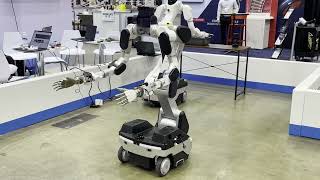
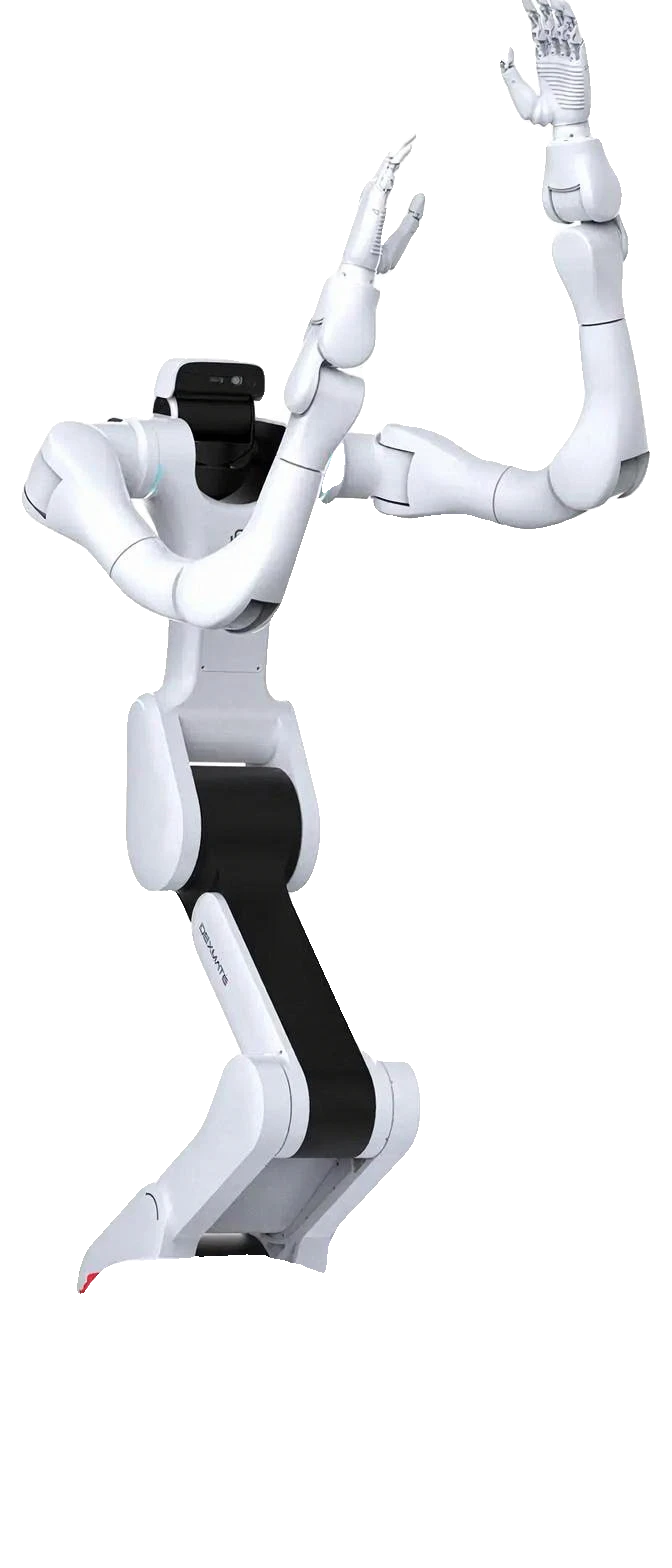
Vega, manufactured by Dexmate, represents a breakthrough in general-purpose mobile humanoid robots, launched in early 2025 and entering production with pre-orders at approximately $96,000. Designed primarily for industrial automation, R&D, manufacturing, logistics, and retail sectors, Vega addresses labor shortages through its versatile architecture combining high dexterity, payload capacity, and mobility. Unlike legged humanoids, Vega employs an omni-directional wheeled base for precise, efficient navigation at speeds up to 4 km/h, eliminating walking-related energy inefficiencies while maintaining a low profile for human-safe collaboration. The robot's core architecture features a highly configurable kinematic chain with 36+ degrees of freedom (DOF): a 3-DOF flexible head for panoramic spatial perception, 3-DOF adjustable torso enabling vertical extension from compact storage to a maximum reach of 2.2 meters (7'2"), and dual 13-DOF dexterous arms (7-DOF shoulder/elbow/wrist + 6-DOF five-fingered hands per arm). This setup supports bimanual manipulation of heavy objects up to 15 kg (33 lbs) per arm at any pose, ideal for assembly, inspection, picking, and high-reach tasks. The foldable torso and arms allow seamless transition between deployed and transport modes, weighing 135 kg overall with aluminum structural framing for durability and lightness. Propulsion relies on brushless motors paired with harmonic gear reductions for smooth, quiet, backlash-free motion. Sensing is comprehensive: multiple RGB/RGBD cameras for vision, LiDAR for SLAM/navigation, IMUs for odometry/orientation, ultrasonic sensors for obstacle avoidance, force/torque sensors on joints/end-effectors, and tactile touch sensors on hands. Safety features include fast self-collision avoidance, compliance control, and human-proximate operation logic. Compute architecture leverages NVIDIA Jetson AGX Orin (up to 64GB RAM, with Thor upgrade imminent) for edge AI processing, augmented by Intel x86 CPUs. Running Linux with an open ROS/Python stack, it offers pip-installable APIs, URDF/USD models for simulators like NVIDIA Isaac Gym/GR00T, and rich peripherals (4x USB 3.2, Ethernet, DisplayPort, 5V/12V rails). LLM integration enables natural-language interfaces for tasking and skill re-authoring, supporting generative AI pipelines for policy learning from demos/teleop (VR/exoskeleton compatible). No proprietary closed-source models are specified; emphasis is on developer-friendly extensibility. Real-world deployments include pilots with public companies in manufacturing/logistics/retail as of mid-2025, showcased at ProMat 2025, NVIDIA GTC, and ICRA events. Developed in under six months by a team from MIT, CMU, UCSD, NVIDIA, and TRI, Vega boasts 20+ hour runtime (up to 30+ hours light bimanual motion) on a high-capacity battery, with 3-month lead times. Its scalability supports fleet management, positioning it for warehouse automation, assembly lines, and research in dexterous manipulation. Early demos highlight barbell lifting, household chores, and precision handling, underscoring its transition from prototype to deployable platform amid the 2025 humanoid surge.

Key Features

Foldable Extendable Design

Unique torso and arm folding mechanism stretches to 2.2m reach for overhead tasks, collapses compactly for easy transport and storage.

High-Payload Dexterous Arms

Dual 13-DOF arms with 15kg payload per arm at full extension, equipped with 6-DOF touch-sensing hands for bimanual heavy-lift and fine manipulation.

Omni-Directional Wheeled Base

Enables holonomic movement in any direction at 4 km/h, optimizing for indoor navigation without legged instability.

Edge AI Compute

NVIDIA Jetson AGX Orin (64GB) for real-time perception/planning, ROS/Python SDK, LLM integration for voice-commanded tasks.

Rich Multi-Modal Sensing

RGBD cameras, LiDAR, IMUs, ultrasonics, F/T, tactile sensors enable robust SLAM, obstacle avoidance, and compliant interaction.

Extended Runtime

High-capacity battery delivers 20+ hours continuous operation, up to 30+ hours light use, supporting shift-long deployments.

Developer Ecosystem

Pip-install API, URDF/USD sim models, VR teleop, fleet management for rapid prototyping and scaling.

Specifications

AvailabilityIn production
NationalityUK
Websitehttp://dexmate.ai
Degrees Of Freedom, Overall36
Degrees Of Freedom, Hands12
Height [Cm]171
Manipulation Performance2
Navigation Performance2
Max Speed (Km/H)4
Strength [Kg]15
Weight [Kg]135
Runtime Pr Charge (Hours)20
Safe With HumansYes
Cpu/GpuIntel x86, Nvidia Jetson
ConnectivityBluetooth, Ethernet, USB, WiFi
Operating SystemLinux
Llm IntegrationYes
Motor TechBrushless Motor
Gear TechHarmonic Gear reduction
Main Structural MaterialAluminium
Number Of Fingers10
Main MarketIndustrial automation, R&D
VerifiedNot verified
ManufacturerDexmate
Dof Overall36+
Dof Arms13 per arm (7 serial + 6 hand)
Dof Head3
Dof Torso3
Height Nominal171 cm
Height Max220 cm
Weight135 kg
Payload Per Arm15 kg
Max Speed4 km/h
Runtime20+ hours (30+ light use)
BatteryHigh-capacity Li-ion, voltage/capacity unspecified, swappable
ComputeNVIDIA Jetson AGX Orin 64GB, Intel x86; Thor upgrade planned
Os SoftwareLinux, ROS/Python SDK, LLM optional
Sensors['RGB/RGBD cameras (resolution unspecified)', 'LiDAR', 'IMUs', 'Ultrasonic proximity', 'Force/Torque (joints/end-effector)', 'Tactile touch sensors (hands)']
ActuatorsBrushless DC motors, harmonic gear reduction
MaterialsAluminum frame
ConnectivityBluetooth, Ethernet, 4x USB 3.2, WiFi, DisplayPort, 5V/12V rails
MobilityOmni-directional wheeled base
Hands10 fingers (5 per hand), 6 DOF each
Price$96,000 (hardware only)

Curated Videos

Video 1
Video 2
Video 4
Video 5

Frequently Asked Questions

What is the maximum payload capacity of Vega's arms?

Each arm handles 15 kg (33 lbs) at any pose, thanks to robust brushless motors and harmonic gearing. This enables heavy lifting like tools or boxes in industrial settings, with force/torque feedback for safe handling. Dexterous hands add precision for objects up to 10+ lbs bimanually.

How long does the battery last on a single charge?

Vega offers 20 hours typical runtime per charge, extending to 30+ hours for light bimanual tasks without payload. The high-capacity battery supports full-shift operations in warehouses or labs, with quick-swap design for continuous use in deployments.

What computing hardware powers Vega?

NVIDIA Jetson AGX Orin (up to 64GB RAM) provides edge AI compute, paired with Intel x86 CPUs. Upcoming Thor upgrade enhances performance. Rich I/O includes USB/Ethernet for peripherals, enabling ROS/Python development and LLM integration.

Is Vega safe for human collaboration?

Yes, with built-in safety features like self-collision avoidance, compliance control via F/T sensors, ultrasonic proximity detection, and quiet operation. Designed for side-by-side work in factories, it meets industrial human-robot interaction standards.

What software stack does Vega use?

Linux OS with open ROS-compatible SDK, pip-installable Python API, and URDF/USD files for simulators. Supports teleoperation, LLM tasking, and custom AI models, making it ideal for researchers and integrators.

What are the dimensions and weight of Vega?

Nominal height 171 cm, extends to 220 cm; weight 135 kg. Foldable design minimizes footprint for shipping/storage, with aluminum frame balancing strength and portability.

What sensors are integrated into Vega?

Comprehensive suite: RGB/RGBD cameras for vision, LiDAR for mapping, IMUs/ultrasonics for localization/avoidance, F/T on arms, tactile on hands. Enables advanced perception for dexterous tasks and navigation.

What are typical use cases for Vega?

Industrial: assembly, inspection, logistics picking; R&D: manipulation research. Pilots in manufacturing/retail show heavy-lift, bimanual chores. Scalable fleets for warehouses addressing labor gaps.

×