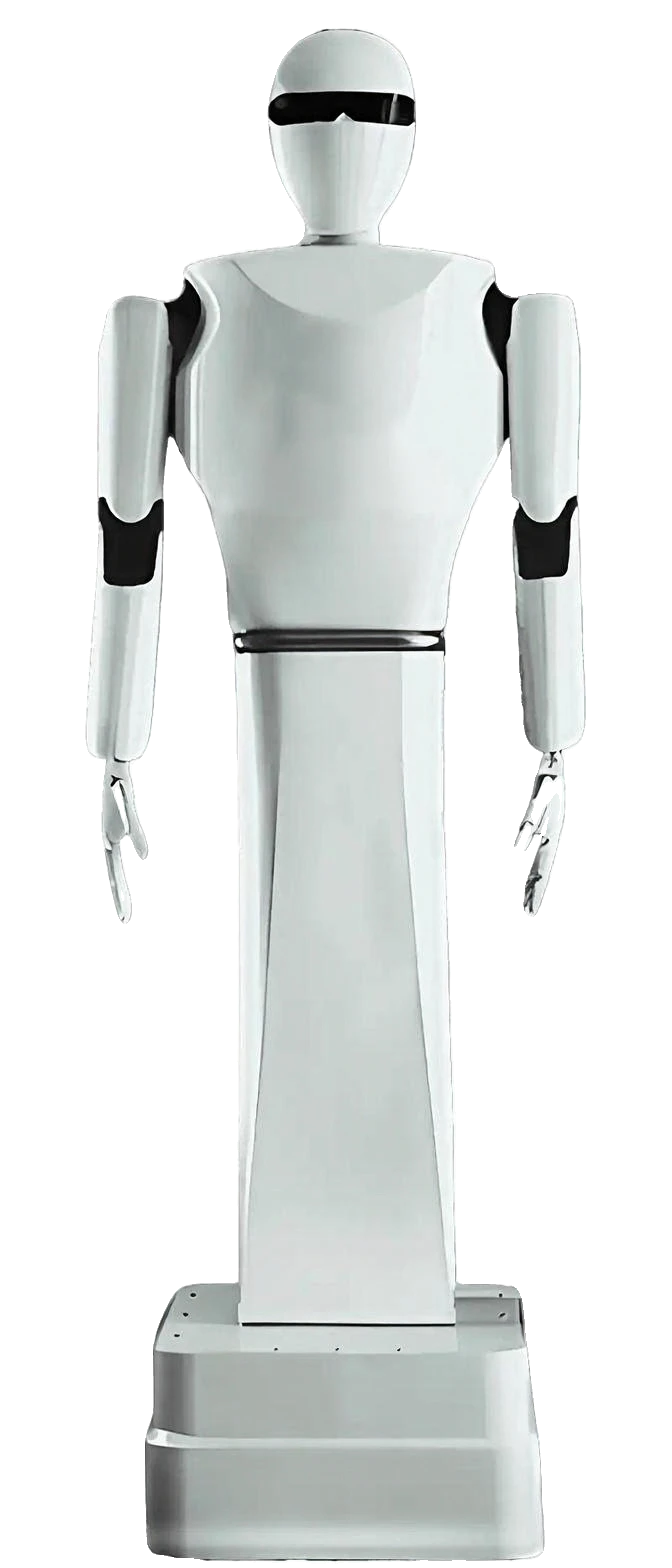
Spaceo M1
Muks Robotics

Spaceo M1

Spaceo M1 is a 167 cm social humanoid from India’s Muks Robotics that rolls at 7 km h, lifts up to 60 kg (100 kg peak) and runs a Linux-based multimodal LLM on board, offering four-plus hours of service for reception, retail and healthcare at a starting price of roughly $11 000.

Description

The Spaceo M1, developed by Muks Robotics, an innovative AI humanoid robotics company founded in 2021 and headquartered in Pune, India, represents a significant milestone in affordable, practical service robotics. Launched in March 2025 following the Spaceo Pro industrial variant, the M1 is a wheeled social humanoid designed for human-centric environments such as reception areas, retail stores, healthcare facilities, hospitality venues, and malls. Measuring 167 cm in height, 480 mm wide, and 450 mm deep at neutral position, it weighs between 45-65 kg (sources vary), ensuring a sturdy yet approachable presence at eye level for most adults. Its wheeled base enables a maximum speed of 7.2 km/h (2 m/s), prioritizing stability and efficiency over bipedal locomotion, which allows for reliable navigation in crowded spaces without the energy drain of legged systems. At the heart of Spaceo M1's capabilities is the proprietary FusionMax Omni-Modal AI stack, a Vision-Audio-Language-Action (VALA) model boasting 2 billion optimized parameters, trained extensively on real-world data. This on-device, Linux-based multimodal LLM fuses inputs from an RGB camera, 3D LiDAR for depth perception and SLAM, a four-microphone array for voice localization and noise cancellation, and tactile sensors on grippers and body for feedback. Running on an Intel Core i5 processor with 16 GB RAM and 500 GB SSD, augmented by an NVIDIA GPU module for accelerated inference, FusionMax enables low-latency, offline operation. It processes visual scenes for object recognition and path planning, audio for multilingual speech-to-text (supporting Indian languages and English), and proprioceptive data to generate coherent responses, emotional expressions via facial LEDs, natural dialogue, and precise manipulations. The AI excels in long-form conversations, emotion recognition, domain-specific knowledge injection, and autonomous task execution, with open APIs for customization and OTA updates via WiFi/Bluetooth connectivity. Mechanically, the robot features 16 degrees of freedom across neck, torso, and dual arms (6 DOF per arm with 650 mm reach), driven by electric servo actuators equipped with dual encoders for sub-millimeter precision and harmonic/cycloidal gearboxes for torque efficiency. Hands have 10 fingers for dexterous gripping. Lifting capacity is rated at 20-60 kg per arm (100 kg peak on trunk/load carrier), suitable for handling luggage, medical supplies, or retail stock. The aluminum frame with composite skins provides durability, while ingress protection details are unspecified but safe for human interaction. Power is supplied by a battery offering 4+ hours of runtime, charged via a 25V 10A system, with local fan cooling for thermal management during intensive AI compute or mobility. As of December 2025, Spaceo M1 remains in early production with pre-orders starting at approximately $11,000, targeting mass-market accessibility. Real-world deployments are nascent; demos showcased at events like the India Today Conclave and upcoming International Humanoid Summit at IIT highlight capabilities in greeting, assistance, and restocking. No large-scale customer case studies are public, but pilots in Indian hospitality and healthcare are implied, addressing labor shortages. Gen 2 and Gen 3 iterations are in development, promising enhanced autonomy and integration. Muks Robotics' focus on cost-effective, AGI-like physical intelligence positions Spaceo M1 as a pioneer for emerging markets, bridging the gap between research prototypes and deployable service robots.

Key Features

FusionMax Omni-Modal AI

Proprietary 2B parameter VALA model enabling on-device processing of vision, audio, language, and actions for multilingual dialogue, emotion recognition, and autonomous decision-making.

High Payload Capacity

Dual arms lift up to 60 kg each (100 kg peak trunk), with 650 mm reach and 10-finger grippers for handling retail goods, medical kits, or luggage.

Advanced Navigation

Wheeled base reaches 7.2 km/h, using 3D LiDAR and SLAM for obstacle avoidance and path planning in dynamic environments like malls or hospitals.

On-Device Autonomy

Intel i5 + NVIDIA GPU runs full AI stack offline, with OTA updates and open APIs for customization and integration.

Human-Like Interaction

Lifelike expressions via LEDs, HP Stereo 5W speakers, 4-mic array for natural, emotional conversations across multiple languages.

Specifications

AvailabilityIn production
NationalityIndia
Websitehttp://muksrobotics.com
Degrees Of Freedom, Overall16
Height [Cm]167
Manipulation Performance2
Navigation Performance2
Max Speed (Km/H)7.2
Strength [Kg]20
Weight [Kg]65
Runtime Pr Charge (Hours)4
Safe With HumansYes
Cpu/GpuIntel Core i5, NVIDIA
Camera ResolutionRGB camera (resolution not stated) + 3-D LiDAR
ConnectivityBluetooth, OTA updates, WiFi
Operating SystemLinux, Linux-based FusionMax Omni-Modal AI stack
Llm IntegrationYes – on-device multimodal LLM for multilingual dialogu
Motor TechElectric servo actuators
Gear Techharmonic/cycloidal
Main Structural MaterialAluminium, harmonic/cycloidal
Number Of Fingers10
Main Markethealthcare, Hospitality, retail restocking
VerifiedNot verified
ManufacturerMuks Robotics
Dimensions1670 x 480 x 450 mm (height x width x depth at neutral)
Weight45-65 kg (with battery; sources vary)
Dof Overall16
Dof Arm6 per arm
Max Speed7.2 km/h (2 m/s)
Payload60 kg per arm, 100 kg peak trunk
Reach650 mm per arm
Fingers10
CpuIntel Core i5, 16 GB RAM, 500 GB SSD
GpuNVIDIA (high-compute AI module, model unspecified)
OsLinux with FusionMax stack
SensorsRGB camera, 3D LiDAR, 4-microphone array, tactile feedback sensors
AudioHP Stereo 5W speakers
MotorsElectric servo actuators with dual encoders
GearsHarmonic/cycloidal
MaterialsAluminum frame, composite skins
Battery4+ hours runtime, 25V 10A charger
CoolingLocal fan system
ConnectivityWiFi, Bluetooth, OTA updates

Curated Videos

Video 1
Video 2
Video 3

Frequently Asked Questions

What is the primary AI system in Spaceo M1?

FusionMax Omni-Modal AI, a 2B parameter Vision-Audio-Language-Action model trained on real-world data. It processes multimodal inputs on-device via Intel i5 and NVIDIA GPU, enabling offline multilingual conversations, emotion detection, navigation, and task execution with low latency.

How long does the battery last and how is it charged?

The battery provides over 4 hours of continuous operation per charge under typical service loads. It uses a 25V 10A charger with local fan cooling for thermal management during recharges and high-compute tasks.

What are the manipulation capabilities?

16 DOF total, with 6 DOF per arm (650 mm reach), 10-finger hands, and lifting up to 60 kg per arm or 100 kg peak on trunk. Electric servos with harmonic/cycloidal gears ensure precise, repeatable movements for grasping and carrying.

What sensors does it use for perception?

RGB camera for visual recognition, 3D LiDAR for depth mapping and SLAM, 4-microphone array for voice processing, and tactile sensors for force feedback. These feed into FusionMax for comprehensive environmental understanding.

Is it suitable for human-shared spaces?

Yes, designed safe with humans via soft composites, sub-millimeter precision encoders, and AI-driven collision avoidance. Wheeled stability prevents falls, ideal for crowded retail, hospitality, or healthcare settings.

What is the pricing and availability?

Starting at around $11,000 for pre-orders. In production as of 2025, with mass production ramping up. Contact Muks Robotics for demos, pilots, or custom integrations via open APIs.

Can it operate offline?

Fully autonomous offline thanks to on-board compute. FusionMax handles all inference locally, with optional cloud sync for updates or domain knowledge, ensuring reliability in low-connectivity areas.

×