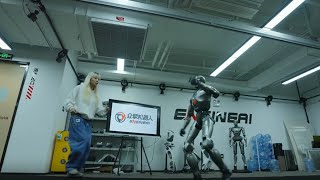
PM01
EngineAI Robotics

PM01

The EngineAI PM01 is a next-generation humanoid robot that combines affordability, agility, and research-focused design. Engineered for both academic and commercial use, it serves as a versatile testbed for AI and robotics research. Unlike many high-cost humanoids, PM01 is open-source, allowing researchers and developers to experiment with AI models, locomotion control, and human-robot interaction. With its highly adaptive bipedal walking gait, PM01 mimics human movement more fluidly than traditional humanoid robots, making it a promising candidate for applications in automation, service robotics, and human-assistive tasks.

Description

The EngineAI PM01 is a groundbreaking lightweight, highly dynamic, fully open-source humanoid robot platform, standing at 138 cm tall and weighing approximately 40-43 kg, designed primarily for research, education, and emerging commercial applications in embodied AI. Launched in December 2024, it represents a scaled-down, more affordable iteration of EngineAI's flagship SE01, emphasizing agility, openness, and human-like motion. Architecturally, PM01 features a full-stack proprietary actuator system with planetary gear joints (Q25H for Education Edition, Q90H for Business Edition), hollow-shaft designs for internal cable routing, dual encoders for precision, and peak torque densities up to 130 Nm/kg (145 Nm max torque in Business Edition). Total degrees of freedom range from 23 (Business) to 24 (Education), with exceptional joint ranges: 320° waist rotation, hip R -29° to +134°, P -180° to +140°, Y -90° to +230°, and knee -30° to +137°, enabling superhuman maneuvers like the world's first autonomous front flip, axe dance, running at >2 m/s (7.2 km/h), human-like bipedal gait, and all-terrain adaptation. At its core, PM01 employs an end-to-end neural network architecture trained on optical motion capture data via simulation, incorporating adversarial learning, reinforcement learning (RL), and deep learning (DL) frameworks. This allows rapid adaptation to complex terrains, optimal strategy mastering, and fluid motion replication far surpassing traditional rule-based controls. The EngineAI ROS Deployment Framework supports dual-mode (simulation-to-real) transitions, with open-source repositories for training (RL/DL integration) and deployment codes, exposing low-level hardware interfaces for custom AI models. Computing power includes a 4-core high-performance CPU (likely Intel N97 X86 architecture) in both editions, augmented by NVIDIA Jetson Orin NX 16GB module in the Education Edition for advanced perception and processing. Perception relies on dual depth cameras (head and waist, compatible with Intel RealSense), enabling visual odometry, obstacle avoidance, and environmental mapping. The exoskeleton uses lightweight aluminum alloy for structural integrity, balancing aesthetics with dynamic performance, featuring signature star halo lighting (eyes and buttocks) and an interactive core touchscreen for commands and feedback, inspired by Iron Man interfaces. Power is provided by a quick-release 10,000 mAh smart battery at 54.6V (4.5A charging), yielding ~2 hours runtime per charge. No specific thermal management details are public, but the design prioritizes heat dissipation through hollow joints and high RPM motors (up to 8400 rpm). Real-world deployments highlight PM01's prowess: showcased at CES 2025 with SE01/SA01, performing front flips; IROS 2025 demos of agile power moves; public running in Shenzhen Talent Park (March 2025); and kung fu dances mimicking cinema. EngineAI, founded 2023 in Shenzhen, has delivered ~100 units across models in months, with partnerships like Duolun Tech for 2,000+ scenario-specific deployments. Priced accessibly (~$12,000-14,000 USD introductory via resellers, up to $25k+), PM01 democratizes humanoid research, fostering AGI pursuits through ecosystem co-creation. Ongoing software updates (e.g., PM01.1.0.7, Nov 2025) enhance stability and capabilities, positioning it as a versatile testbed for locomotion, manipulation, and human-robot interaction.

Key Features

Exceptional Mobility and Agility

≥23-24 DoF with 320° waist rotation, enabling world's first front flip, axe dance, 2 m/s running, and human-like gait on varied terrains via advanced body control algorithms.

Full-Stack Proprietary Actuators

Self-developed planetary joints (Q25H/Q90H) with hollow shafts, dual encoders, peak 145 Nm torque, 130 Nm/kg density, and up to 8400 rpm for precise, stable motion.

AI-Driven End-to-End Learning

Neural networks trained on mocap data with RL/DL/adversarial methods; open-source ROS framework for sim-to-real adaptation and custom model deployment.

Open-Source Ecosystem

Low-level hardware interfaces, training/deployment code repos, supporting research in AI locomotion, HRI, and automation.

Interactive Personified Design

Core touchscreen, depth cameras, star halo lights for intuitive control, visual feedback, and multi-dimensional human-robot interaction.

Dual Editions for Versatility

Business (high-torque) and Education (Jetson Orin NX, secondary dev support) versions tailored for commercial dynamics and academic research.

Specifications

AvailabilityPrototype
NationalityChina
Websitehttps://www.engineai.com.cn/
Degrees Of Freedom, Overall24
Height [Cm]138
Manipulation Performance3
Navigation Performance3
Max Speed (Km/H)7.2
Strength [Kg]15
Weight [Kg]40
Runtime Pr Charge (Hours)2
H.G Skill Score4
VerifiedNot verified
ManufacturerEngineAI Robotics
Height Cm138
Standing Dimensions Mm1400 x 535.55 x 252.66 (H x W x D)
Weight Kg40-43 (including battery)
Dof Total23-24
Dof Arm Single5
Dof Leg6
Waist Rotation Deg320
Max Speed Mps2
Processors['4-core CPU (Intel N97)', 'NVIDIA Jetson Orin NX 16GB (Education)']
Sensors['Dual depth cameras (head & waist, Intel RealSense-like)']
Motorsmodels: ['Q25H (Edu)', 'Q90H (Business)'], type: Planetary gear, hollow-shaft, dual encoder, max_torque_nm: 50 (Edu) / 145 (Business), peak_torque_density_nm_kg: 100-130, max_rpm: 6400-8400, reduction_ratio: 25, joint_weight_kg: 0.5-1.1
Batterycapacity_mah: 10000, voltage_v: 54.6, charge_current_a: 4.5, runtime_hours: 2, charge_time_hours: 2
MaterialsAluminum alloy exoskeleton
ConnectivityROS framework, handheld remote, touchscreen (Edu)
Os FrameworkEngineAI ROS Deployment (open-source)

Curated Videos

Video 1
Video 2
Video 3
Video 4
Video 5

Frequently Asked Questions

What are the main differences between Business and Education Editions?

Business Edition prioritizes high torque (145 Nm Q90H motors) for dynamic commercial tasks, weighing 42 kg with 23 DoF. Education Edition adds NVIDIA Jetson Orin NX 16G, touch screen, secondary development support, lighter Q25H motors (50 Nm), and explicit depth cameras, at 43 kg with 24 DoF, ideal for research.

Is the PM01 open-source and what does that include?

Yes, fully open-source with low-level hardware interfaces, ROS deployment framework, training code repos (RL/DL optimized), and deployment codes for model-to-real transitions, enabling ecosystem co-creation without repetitive development.

What is the battery life and charging specs?

Quick-release 10,000 mAh smart battery provides nearly 2 hours runtime. Charges at 54.6V 4.5A, taking about 2 hours for full charge, supporting extended research sessions or demos.

What processors and computing power does it have?

4-core high-performance CPU (Intel N97 equivalent) standard; Education Edition includes NVIDIA Jetson Orin NX 16GB for AI inference, perception, and high-compute tasks like neural network processing.

What sensors are used for perception?

Dual depth cameras at head and waist (likely Intel RealSense compatible) for visual perception, enabling real-time environmental mapping, obstacle detection, and motion adaptation in Education Edition.

What is the approximate price and availability?

Introductory pricing ~88,000 CNY ($12,000-14,000 USD) until March 2025 via official store or resellers (up to $25k+); available now for global purchase in prototype/commercial stages for research/education.

Can it perform advanced maneuvers like front flips?

Yes, PM01 achieved the world's first autonomous front flip, plus axe dance, running, and natural gaits, thanks to end-to-end NN training and high DoF joints.

×