Optimus
Tesla

Optimus

Optimus, Tesla‘s humanoid robot,represents a significant leapforward in thefield of robotics and artificial intelligence.Unveiled in 2021 and continuouslyevolving, Optimus embodies Tesla’s vision of creating aversatile, autonomousrobot capableof performing a wide rangeof tasks in bothindustrial and domestic settings.

Description

Tesla's Optimus humanoid robot represents a pinnacle of integrated AI and robotics engineering, designed as a general-purpose, bipedal machine to execute unsafe, repetitive, or mundane tasks in industrial, warehouse, and eventually domestic environments. First unveiled as a concept in 2021 at Tesla's AI Day, Optimus has rapidly iterated through prototypes, with significant milestones in Gen 2 (2024) and the ongoing Gen 3 pilot production as of late 2025. The robot's architecture mirrors human proportions for compatibility with human-designed spaces: standing 173 cm tall, weighing approximately 57 kg, with a payload capacity of 20 kg and maximum speed of 8 km/h. Its skeletal structure employs custom electromechanical actuators—over 28 degrees of freedom overall, escalating to 22 DoF in the hands alone for Gen 3—crafted in-house because no commercial equivalents met the torque, precision, and efficiency requirements. These include proprietary servo motors, planetary gearboxes, and high-resolution encoders, vertically integrated to achieve a target cost of $20,000 per unit at scale. At the core of Optimus is Tesla's end-to-end neural network architecture, directly adapted from its Full Self-Driving (FSD) system used in autonomous vehicles. Vision is primary, relying on multiple high-resolution cameras (similar to Autopilot's suite: forward-facing, side, and rear with resolutions up to 5MP) processed via transformer-based models for perception, planning, and control. No lidar or radar; pure vision with inertial measurement units (IMUs), force-torque sensors in joints, and tactile feedback in grippers enable dynamic balance, obstacle avoidance, and dexterous manipulation. The on-board compute leverages Tesla's HW-AI5 inference chips (successor to HW4), capable of trillions of operations per second for low-latency (sub-100ms) glass-to-action response. Training occurs on the Dojo supercomputer, utilizing petabytes of video data from Tesla's vehicle fleet, factory teleops, and physics-based simulations to bootstrap capabilities like heel-to-toe walking, running, object sorting, egg handling, and even rudimentary dancing or kung-fu motions—all demonstrated autonomously in 2025 videos. Deployment history underscores rapid progress: Early 2023 prototypes shuffled awkwardly; by mid-2024, Gen 2 walked 30% faster (2.5+ km/h sustained), autonomously navigated offices, and performed yoga. November 2025 marked a breakthrough with Fremont Factory pilot production running, deploying dozens for real-world testing in sorting, battery handling, and self-charging. Elon Musk announced unsupervised 24/7 operation in Palo Alto labs, gathering data for refinement. Plans target thousands of units internally by mid-2026 across factories (Fremont, Texas, Shanghai), addressing labor shortages in assembly and logistics. External sales eyed for H2 2026 at $20-30k, with mass production scaling to 1M+/year. Challenges persist: a December 2025 demo collapse highlighted autonomy limits in edge cases, fueling debates on teleop reliance, though Tesla asserts full neural net control. Battery is a 2.3 kWh pack using 4680 cells, yielding 8 hours of mixed tasks with efficient thermal management via liquid cooling. Optimus embodies Tesla's physics-first, data-centric approach, positioning it as a frontrunner in humanoid robotics amid competitors like Figure and Boston Dynamics.

Key Features

End-to-End AI Autonomy

Powered by neural networks akin to FSD, enabling vision-based perception, path planning, manipulation, and locomotion without hardcoded rules.

Advanced Dexterity

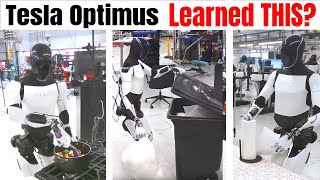
Gen 3 hands with 22 degrees of freedom support delicate tasks like egg handling, shirt folding, and tool use.

Bipedal Mobility

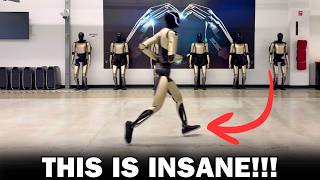
Heel-to-toe walking, running at up to 8 km/h, dynamic balance on varied terrain using IMUs and force sensors.

Onboard Inference Compute

Tesla HW-AI5 chips for real-time processing, low-latency actions, and full autonomy without cloud dependency.

Efficient Power System

2.3 kWh battery with 4680 cells provides 8+ hours runtime; self-charging capability demonstrated.

Human-Safe Design

Lightweight build (57 kg), speed-limited actuators, and rounded features prioritize safe human coexistence.

Specifications

AvailabilityPrototype
NationalityUS
Websitehttps://www.tesla.com/en_eu/AI
Degrees Of Freedom, Overall22
Height [Cm]173
Manipulation Performance2
Navigation Performance2
Max Speed (Km/H)8
Strength [Kg]20
Weight [Kg]56
Runtime Pr Charge (Hours)1
H.G Skill Score6
VerifiedNot verified
Walking Speed [Km/H]2.5
ManufacturerTesla
Height Cm173
Weight Kg57
Payload Kg20
Max Speed Kmh8
Walking Speed Kmh2.5
Dof Overall28
Dof Hands22
Battery Capacity Kwh2.3
Battery Chemistry4680 cells
Runtime Hours8
SensorsMultiple high-res cameras (Autopilot suite), joint force-torque sensors, IMUs, tactile grippers
ProcessorsTesla HW-AI5 inference compute (on-board neural net acceleration)
ActuatorsCustom servo motors, planetary gearboxes, high-res encoders
MaterialsLightweight composites and metals for structure
Thermal ManagementLiquid cooling system
ConnectivityWiFi, potential LTE for fleet management
OsCustom real-time OS with neural net runtime

Curated Videos

Video 1
Video 2
Video 3
Video 4
Video 5

Frequently Asked Questions

What is the current status of Optimus production?

As of December 2025, Tesla's Fremont Factory runs a pilot production line for Gen 3 Optimus, deploying units internally for factory tasks. Larger-scale production targets 10,000+ units in 2026 for broader internal use before external sales.

What AI technology powers Optimus?

Optimus uses end-to-end neural networks trained on Dojo, mirroring Tesla FSD. Vision-only inputs from cameras enable autonomous navigation, manipulation, and learning from video demonstrations without traditional programming.

How long does the battery last?

The 2.3 kWh battery pack supports approximately 8 hours of continuous mixed tasks like walking and manipulation. Optimus demonstrates self-charging, docking autonomously to extend operational uptime in deployments.

What are the robot's physical capabilities?

Standing 173 cm tall and weighing 57 kg, it carries 20 kg payloads, walks/runs up to 8 km/h, and features 22 DoF hands for human-like dexterity in tasks from sorting to delicate handling.

When can consumers buy Optimus?

Internal Tesla deployment scales in 2026; external sales projected H2 2026 or 2027 at $20,000-$30,000 per unit, contingent on proving reliability in real-world factory pilots.

Is Optimus safe around humans?

Designed with safety in mind: lightweight materials, speed capped at 5-8 mph, force-limited actuators, and AI-driven collision avoidance ensure non-threatening interaction in shared spaces.

×