HIVA Haiwa
Haier

HIVA Haiwa

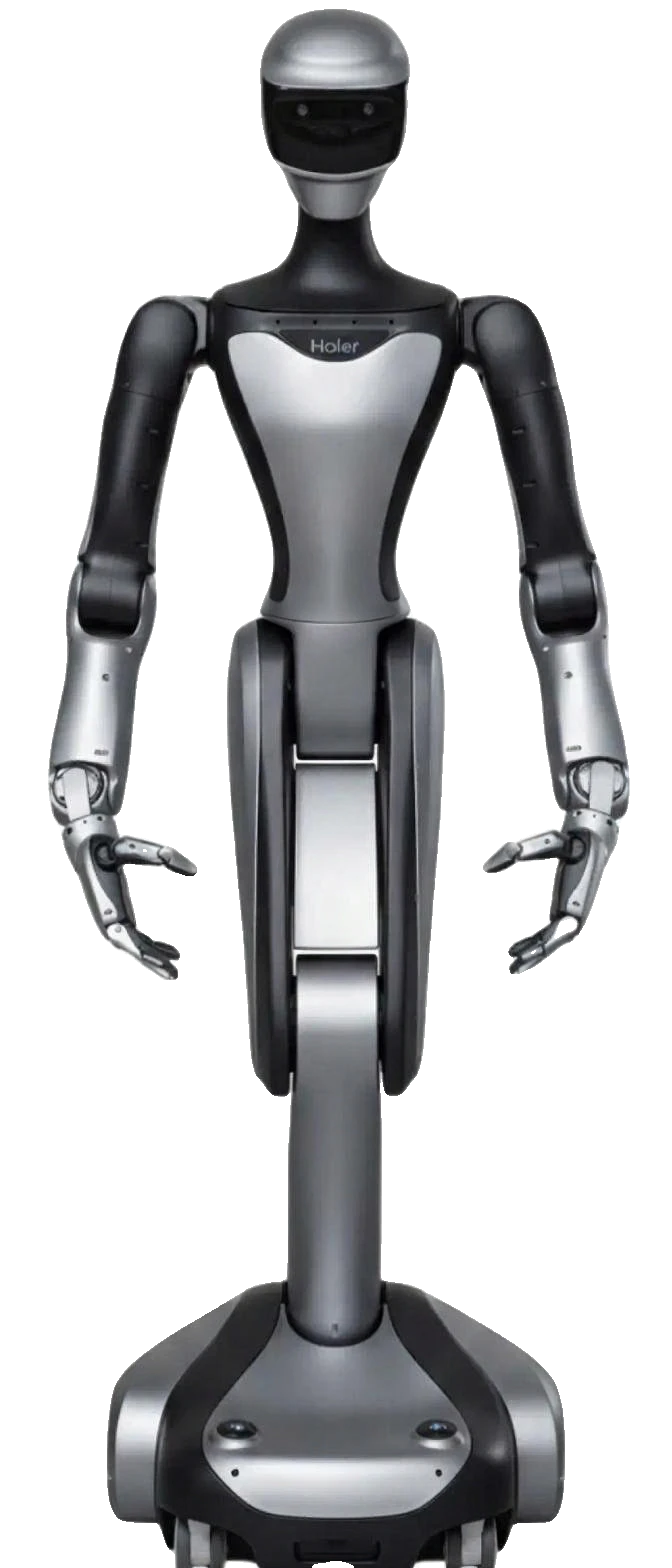
The HIVA Haiwa is a165 cmwheeled humanoid robot from Haier,created as an advanced domestic helper.It features44 degrees of freedomand dexterous hands,allowing it to integrate with and operate smart home appliances.The robot handles a wide array of chores,from cooking and cleaning to complex laundry tasks like ironing and folding clothes.

Description

The HIVA Haiwa, also known as 'HIVA 海娃', is a cutting-edge wheeled humanoid robot developed by Haier Group in collaboration with Beijing Xingdong Jiyuan Technology Co., Ltd. (potentially based on RobotEra's Q5 platform). Unveiled on July 26, 2025, at the AWE 2025 China Appliance and Consumer Electronics Expo, it stands at 165 cm tall, weighs 70 kg, and is positioned as the ultimate 'Housework Terminator' for smart home environments. This prototype robot is engineered for domestic assistance, targeting chores such as floor cleaning, cooking, laundry management, ironing, folding clothes, and operating Haier smart appliances, serving Haier's 1 billion global users. Architecturally, HIVA Haiwa features a stable wheeled mobile base for efficient, fall-resistant navigation in cluttered indoor spaces, achieving max speeds of 4 km/h (walking equivalent 2.5 km/h). It boasts 44 degrees of freedom overall, with 12 DOF in each dexterous 5-finger hand, enabling human-like reach from ground level to 2 meters high and payloads of 3-5 kg per arm. The frame is constructed from lightweight aluminum alloy, driven by electric servo motors paired with harmonic and planetary gears for precise control. Performance metrics include a manipulation score of 3/5 (capable of folding clothes, filling dishwashers) and navigation score of 2/5 (basic obstacle avoidance). On the AI front, the robot operates in a Linux-based ROS environment with an embedded CPU and dedicated AI accelerator. Current demonstrations rely on remote teleoperation by engineers to collect vast datasets for machine learning, focusing on sensor fusion, perception, and real-time decision-making. Sensors encompass machine vision cameras for object recognition, tactile feedback, IMUs for balance, and force/torque sensors in grippers for delicate handling of fabrics and utensils. Connectivity via Wi-Fi, Bluetooth, and Haier Smart Home Network allows seamless integration with appliances like washers, ovens, hobs, fridges, and irons. LLM integration is feasible externally, with glass-to-action latency of 250-450 ms. Future autonomy will leverage cloud-assisted AI trained on teleop data, evolving from supervised learning to independent task execution. Deployment history remains in prototype phase as of December 2025. By September 10, 2025, Haier announced the product form had 'basically matured,' with plans for gradual rollout to B-end (business) and C-end (consumer) markets pending full technological and safety validation. It has been showcased at events like the Qingdao Asia-Pacific Expo, demonstrating tasks such as mopping with floor washers, retrieving/mixing ingredients, removing laundry, ironing/folding/storing clothes, and pet assistance. No commercial deployments yet; emphasis is on data accumulation for refinement. Priced around $80,000 (estimated), with 1-hour runtime per charge and IP20 ingress protection, HIVA Haiwa prioritizes safety around humans and adaptability for elderly or busy households, marking Haier's push into embodied AI for consumer robotics amid China's humanoid boom.

Key Features

Dexterous Hands and Arms

44 DOF total, 12 DOF per hand with 5 fingers, enabling precise gripping, tool use, fabric handling, and 3-5 kg payload per arm for chores like ironing and cooking.

Wheeled Mobility

Stable wheel base for indoor navigation up to 4 km/h, reaching floor-to-2m heights, optimized for cluttered homes without bipedal fall risks.

Smart Home Integration

Seamless connectivity with Haier appliances via Wi-Fi/Bluetooth/Smart Home Network for automated workflows like laundry cycles, oven operation, and fridge access.

Multi-Chore Capabilities

Performs cleaning (mopping, picking rubbish), cooking (heating, mixing), laundry (ironing, folding, storing), and pet care through teleop-trained AI routines.

AI Learning Framework

Teleoperation for data collection, ROS-based with AI accelerator; progressing to cloud AI autonomy via sensor fusion and perception.

Specifications

AvailabilityPrototype
NationalityChina
Websitehttps://www.haier.com/
Degrees Of Freedom, Overall44
Degrees Of Freedom, Hands12
Height [Cm]165
Manipulation Performance3
Navigation Performance2
Max Speed (Km/H)4
Strength [Kg]~3–5 kg payload per arm
Weight [Kg]70
Runtime Pr Charge (Hours)1
Safe With HumansYes
Cpu/GpuEmbedded CPU + AI accelerator
Ingress ProtectionIP20
ConnectivityBluetooth, Smart Home Network, Wi‑Fi
Operating SystemLinux-based ROS environment
Llm IntegrationPossible via external system integration
Latency Glass To Action250–450 ms
Motor TechElectric servo motors
Gear TechHarmonic / planetary gears (assumed)
Main Structural MaterialAluminum alloy frame
Number Of Fingers5 per hand
Main MarketConsumer home use, Home assistance, Home service
VerifiedNot verified
Walking Speed [Km/H]2.5
Shipping Size~180 × 80 × 60 cm crate (assumed)
ColorWhite
ManufacturerHaier
Height165 cm
Weight70 kg
Dof Overall44
Dof Hands12 per hand
Payload Per Arm3-5 kg
Max Speed4 km/h
Walking Speed2.5 km/h
Runtime1 hour per charge
ReachFloor to 2 m
Cpu GpuEmbedded CPU + AI accelerator
OsLinux-based ROS
SensorsMachine vision cameras, tactile sensors, IMUs, force/torque sensors in grippers
ConnectivityWi-Fi, Bluetooth, Haier Smart Home Network
MotorsElectric servo motors
GearsHarmonic / planetary (assumed)
Frame MaterialAluminum alloy
Fingers5 per hand
Ip RatingIP20
Latency250-450 ms glass-to-action
ColorWhite
AvailabilityPrototype, maturing for B/C-end

Curated Videos

Frequently Asked Questions

What is the current autonomy level of HIVA Haiwa?

It is primarily teleoperated by engineers for demonstrations and data training. AI is under development using collected data for future autonomous operation in household tasks, with cloud assistance planned.

What are the main specifications of HIVA Haiwa?

Height 165 cm, weight 70 kg, 44 DOF (12 per hand), wheeled base max 4 km/h, 3-5 kg arm payload, 1-hour runtime, aluminum frame, ROS Linux OS, safe for human interaction.

When will HIVA Haiwa be available for purchase?

As a prototype, product form matured by Sep 2025; gradual B/C-end rollout planned when tech/safety ready. No confirmed consumer release date as of Dec 2025.

What sensors does it use?

Machine vision cameras for recognition, tactile sensors, IMUs for balance, force/torque in grippers for precise manipulation of objects and textiles.

Does it integrate with smart home devices?

Yes, deeply integrates with Haier appliances via smart home network, enabling coordinated tasks like opening washers, operating ovens, and syncing laundry/cooking cycles.

Is HIVA Haiwa safe around humans and pets?

Designed safe with humans per specs; sensors ensure collision avoidance. Demonstrated pet assistance capabilities, suitable for family environments.

×