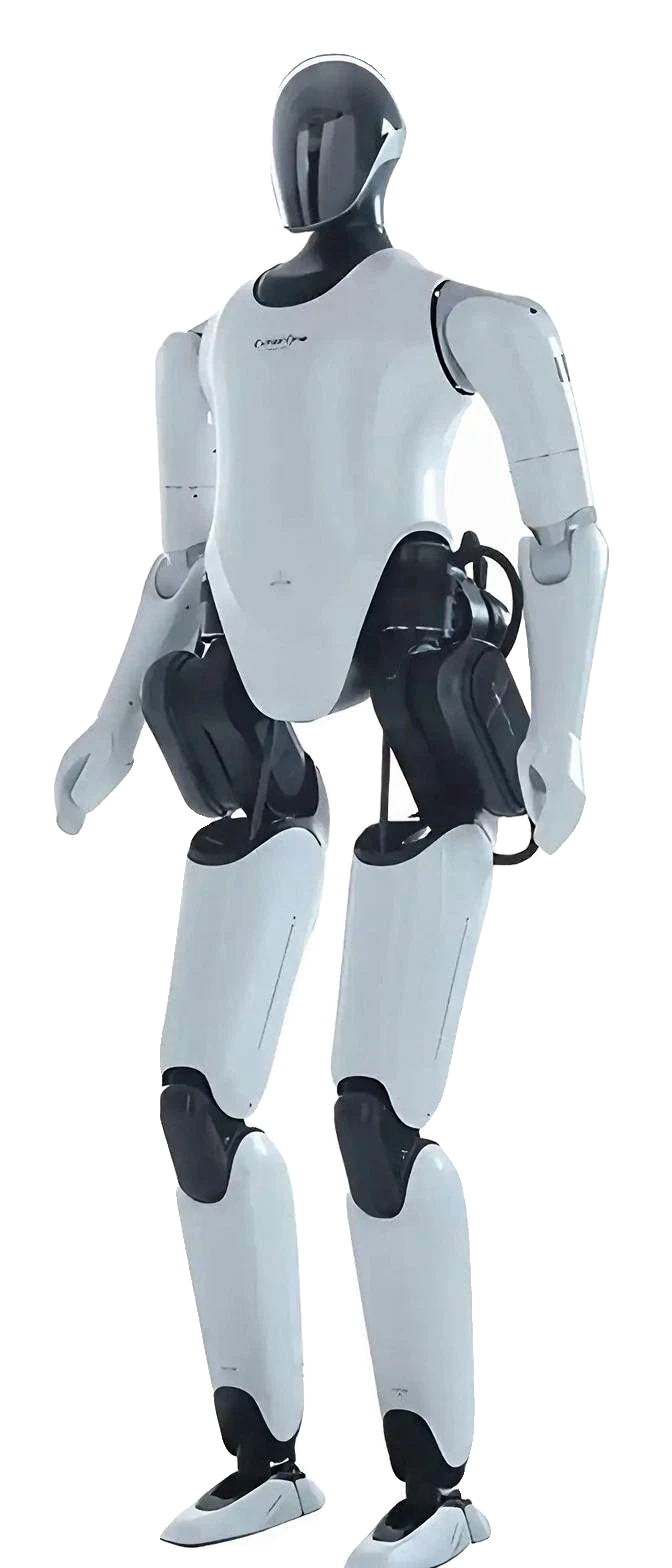
CyberOne
Xiaomi

CyberOne

Xiaomi’s CyberOne is an advanced humanoid robot showcasing AI and robotics expertise. Standing 1.77 meters tall, it features the Mi-Sense AI system, enabling it to recognize emotions, perceive surroundings, and respond to human interactions. With 21 degrees of freedom and rapid response times, CyberOne is physically agile, making it suitable for various tasks in both industrial and domestic environments. Xiaomi sees CyberOne as a foundation for future robotics, envisioning a world where robots seamlessly integrate into daily life.

Description

Xiaomi's CyberOne, unveiled in August 2022, represents the company's inaugural foray into full-size humanoid robotics, developed entirely in-house by the Xiaomi Robotics Lab. Standing at 177 cm tall, weighing 52 kg, with a 168 cm arm span, CyberOne is engineered as a bipedal platform with 21 degrees of freedom (DoF), enabling human-like motion across neck (1 DoF), arms (4 DoF each), legs (5 DoF each), and grippers (1 DoF each). Its architecture integrates high-power-density actuators: upper limb motors weigh just 500g yet deliver up to 30 Nm rated torque, while hip joints peak at 300 Nm instantaneous torque. Each actuator comprises a frameless torque motor, harmonic gearbox, force/torque sensors, dual absolute rotary encoders, and a custom DSP-based controller, facilitating a real-time response of 0.5 ms per DoF. This supports stable bipedal locomotion at walking speeds up to 3.6 km/h (potentially 7.2 km/h running), object manipulation up to 1.5 kg per hand, and dynamic balancing on uneven terrain via proprietary bipedal control algorithms. At its core, CyberOne leverages Xiaomi's Mi-Sense AI suite for multimodal perception. The head mounts an Intel RealSense D455 RGB-D camera for 3D spatial mapping and object/gesture recognition, complemented by a Microstrain 3DM-GX5 IMU in the torso for orientation. Sophisticated microphones power the MiAI environment semantics engine, discerning 85 environmental sounds, and the vocal emotion identification engine, classifying 45 human emotions—from joy to distress, enabling empathetic responses like comforting sad users. A curved OLED 'face' displays real-time interactions. Compute is handled by dual onboard systems: Intel i7/Xeon quad-core processors paired with NVIDIA Jetson Orin NX for AI inference, running Ubuntu Linux, ROS, Python, and MATLAB Simulink. Structural materials include carbon fiber, aluminum, ABS, and silicone for lightweight durability. Power comes from a 1.65 kWh lithium-ion battery, yielding 2.5-3 hours runtime. Safety features emphasize collaborative operation in human environments, with force/torque sensing preventing overloads. Regarding real-world deployment, CyberOne remains a prototype as of late 2025, primarily showcased in demos: launch event interactions, MWC 2023 appearances, drumming performances highlighting whole-body coordination, and emotion detection skits. No commercial units have shipped; Xiaomi denied 2025 mass-production rumors. However, CEO Lei Jun announced plans for scaled humanoid deployment in Xiaomi factories by 2030, targeting repetitive/high-precision tasks, leveraging CyberOne's tech stack. This positions it as a foundational R&D platform, influencing Xiaomi's ecosystem from smart homes to EVs, with ongoing enhancements in AI cognition, biomechatronics, and cloud integration. Challenges persist in scaling manipulation dexterity and energy efficiency, but CyberOne underscores Xiaomi's ambition in the 'crown jewel' of robotics.

Key Features

Advanced Bipedal Locomotion

Self-developed control algorithms enable natural walking, balancing, and speeds up to 3.6 km/h, with high-torque hip motors (300 Nm peak) for dynamic stability.

Mi-Sense 3D Perception

Intel RealSense D455 camera and depth vision module create 3D environmental maps, recognizing people, gestures, and objects in real-time.

Emotion and Audio Recognition

MiAI engines identify 45 human emotions and 85 environmental sounds, allowing empathetic interactions and contextual awareness.

High-Precision Manipulation

21 DoF with 30 Nm arm torque supports 1.5 kg payload per hand, force/torque sensing, and programming by demonstration.

Integrated AI Compute

NVIDIA Jetson Orin NX and Intel processors run ROS-based software for perception, cognition, and execution in human environments.

Specifications

AvailabilityPrototype
NationalityChina
Websitehttp://N/A
Degrees Of Freedom, Overall21
Height [Cm]177
Manipulation Performance2
Navigation Performance2
Max Speed (Km/H)4
Strength [Kg]1.5
Weight [Kg]52
Runtime Pr Charge (Hours)3
H.G Skill Score4
VerifiedNot verified
Walking Speed [Km/H]3.6
ManufacturerXiaomi
Height Cm177
Weight Kg52
Arm Span Cm168
Dof Overall21
Dof BreakdownNeck:1, Arms:4x2, Legs:5x2, Grippers:1x2
Max Payload Kg1.5
Walking Speed Kmh3.6
Response Time Ms0.5
MotorsFrameless torque motors with harmonic gearboxes; upper limb: 500g, 30Nm rated; hip: 300Nm peak
SensorsIntel RealSense D455 RGB-D camera (head), Microstrain 3DM-GX5 IMU (torso), force/torque sensors & rotary encoders (joints), microphones
ProcessorsDual systems: Intel i7/Xeon quad-core + NVIDIA Jetson Orin NX
Os SoftwareUbuntu Linux, ROS, Python, MATLAB Simulink
Battery1.65 kWh lithium-ion, 2.5-3 hours runtime
MaterialsCarbon fiber, aluminum, ABS, silicone
DisplayCurved OLED face for interactions

Curated Videos

Video 1
Video 2
Video 3
Video 4
Video 5

Frequently Asked Questions

What is the current availability of CyberOne?

CyberOne is a prototype robot unveiled in 2022, with no commercial sales as of 2025. Xiaomi continues R&D, planning factory deployments by 2030 for tasks like assembly, but it's not available for purchase.

How does CyberOne recognize human emotions?

Using the MiAI vocal emotion identification engine and microphones, it analyzes audio cues to classify 45 emotions, such as happiness or sadness, enabling responses like verbal comfort during distress.

What are the battery life and power specs?

Powered by a 1.65 kWh lithium-ion battery, CyberOne offers 2.5-3 hours of continuous operation per charge, suitable for demos but requiring improvements for prolonged industrial use.

Can CyberOne perform industrial tasks?

Designed for potential industrial applications, it handles 1.5 kg payloads, navigates human environments, and manipulates objects with 21 DoF, though current prototypes focus on research over production deployment.

What AI models power CyberOne?

Proprietary Mi-Sense for vision/depth, MiAI for semantics/emotions; runs on Jetson Orin NX with ROS/Python, emphasizing real-time perception without specified external LLMs.

×