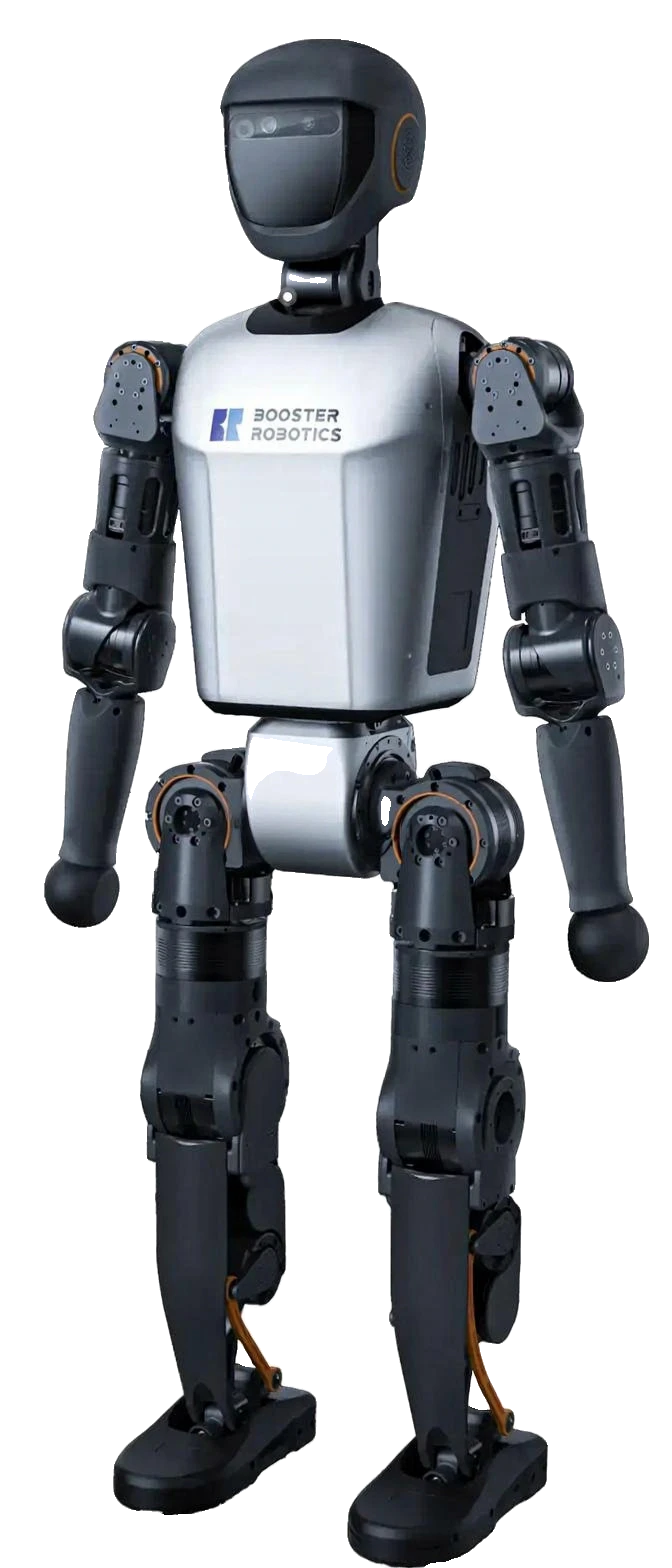
Booster T1
Booster Robotics

Booster T1

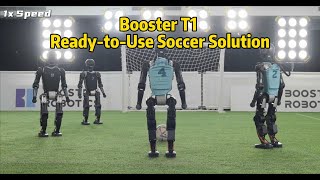
The Booster T1 is a versatile, open-source humanoid robot developed by Booster Robotics, aimed at developers and researchers. Known for its lightweight, flexible, and durable design, the T1 is capable of performing complex tasks like sports and intricate movements such as kung fu. Its advanced motion control system allows for smooth transitions, like rising from a prone position​.

Description

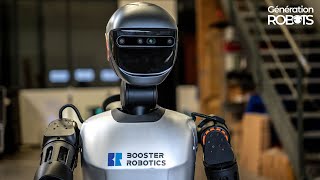
The Booster T1 is an advanced, open-source humanoid robot platform engineered by Booster Robotics, specifically tailored for developers, researchers, and competitive robotics teams. Standing at 118 cm tall and weighing approximately 30 kg, it features a modular bipedal architecture with 23 degrees of freedom (DoF) in its base configuration, expandable to 31 with grippers or 41 with dexterous hands. The design emphasizes lightweight construction, flexibility, and exceptional durability, enabling complex dynamic movements such as omnidirectional walking, sports maneuvers (e.g., soccer kicks), intricate kung fu sequences, and robust fall recovery. Its skeleton comprises a head (2 DoF: yaw and pitch), torso with waist yaw (1 DoF), dual arms (4 DoF each: shoulder pitch/roll/yaw, elbow; extensible), and legs (6 DoF each: hip pitch/roll/yaw, knee, ankle pitch/roll). Joints offer extensive ranges, e.g., hip pitch ±118°, knee 0-123°, with custom Booster motors delivering peak torque up to 130 N·m, dual encoders for precise position/velocity feedback, and hollow-axis design for compactness. At the core of its computational architecture lies a dual-board system: a Motion Control Board powered by Intel Core i7 (Express-i7 with 6P+8E cores up to 4.8 GHz, 8GB RAM, 512GB storage) handling real-time kinematics and dynamics, paired with a Perception Board featuring NVIDIA Jetson AGX Orin 32GB (8-core ARM Cortex-A78AE @2GHz, 200 TOPS AI via Tensor Cores, 32GB RAM, 512GB storage). This setup supports high-fidelity AI inference, reinforcement learning (RL), and multimodal processing. The software stack is ROS2-compatible via Booster Robotics SDK (GitHub: BoosterRobotics/booster_robotics_sdk), with Fast-DDS for low-latency pub/sub and RPC interfaces. Key topics include /tf transforms, joint control (/rt/joint_ctrl), low-state feedback (/rt/low_state with IMU/motor data), and vision streams. Open-source tools like Booster GYM enable RL-based locomotion training, compatible with Isaac Sim and MuJoCo simulations. Sensor suite includes Intel RealSense D455 or Orbbec Gemini 2 355L depth cameras (RGB-D, global shutter IR, 6-axis IMU integration), providing rich point clouds for perception, SLAM, and object detection; a 9-axis IMU for balance/orientation; circular 6-mic array and speaker for audio interaction (e.g., real-time voice with Doubao LLM); optional 3D LiDAR for 360° FOV mapping. Connectivity via WiFi 6, Bluetooth 5.2, dual Gigabit Ethernet (IP: 192.168.10.x), USB/Ethernet expansions, and mobile app/joystick control. Battery is a 10.5 Ah Li-ion pack (torso-mounted, ≤2h charge, ≥500 cycles), yielding 1.5-2 hours walking (0.5 m/s max) or 4 hours standing autonomy, with low-battery/fall alerts and thermal overheat protection. Real-world deployments underscore its prowess: Champion of RoboCup 2025 AdultSize Soccer (Hephaestus Team, Tsinghua University), sweeping medals at World Humanoid Robotics Games Federation 2025; adopted by 50+ teams/institutes including Purdue (table tennis), CMU (FALCON RL), UC Berkeley (FastTD3 RL), Frodobots (fighting games). NVIDIA-endorsed (signed by Jensen Huang), it's now shipping globally for research, competitions, and embodied AI development, bridging simulation-to-real gaps with robust hardware-software integration.

Key Features

Developer-Friendly Open-Source Platform

Comprehensive API interfaces, ROS2-compatible SDK, Booster GYM RL framework, and GitHub resources enable rapid secondary development, simulation in Isaac Sim/MuJoCo, and custom AI integration.

Lightweight and Flexible Design

118 cm height, 30 kg weight, 23-41 DoF with large joint ranges (e.g., hip ±118°), supports agile omnidirectional walking (0.5 m/s), rotation (1.5 rad/s), and complex motions like soccer and martial arts.

High-Performance Computing

NVIDIA Jetson AGX Orin 32GB (200 TOPS AI), Intel i7 motion board, dual 512GB storage, powers advanced RL (FALCON, FastTD3), perception, and decision-making for autonomous tasks.

Advanced Sensing and Perception

RealSense D455/Orbbec Gemini2 depth cameras, 9-axis IMU, 6-mic array, optional LiDAR; enables precise SLAM, obstacle avoidance, object manipulation, and voice interaction.

Durable and Robust

RoboCup 2025 champion; fall recovery, disturbance resistance (uneven terrain, impacts), emergency stops, damping modes; 2h walking endurance, CE/FCC certified.

Expandable End-Effectors

Optional grippers (2kg force, 77mm opening) or dexterous hands (Inspire RH56, 6 DoF/hand, 1-1.5kg grip); extensible for manipulation tasks.

Specifications

AvailabilityPrototype
NationalityChina
Websitehttps://www.boosterobotics.com/
Degrees Of Freedom, Overall23
Height [Cm]118
Manipulation Performance2
Navigation Performance2
Max Speed (Km/H)3.5
Strength [Kg]5
Weight [Kg]30
Runtime Pr Charge (Hours)1.5
H.G Skill Score4
VerifiedNot verified
Walking Speed [Km/H]3.5
ManufacturerBooster Robotics
Height Cm118
Weight Kg30
Dof Total23
Dof Breakdownhead: 2, arms: 4 per arm (expandable to 7), waist: 1, legs: 6 per leg
Processorsperception_board: NVIDIA Jetson AGX Orin 32GB (8-core Cortex-A78AE @2GHz, Tensor Cores @930MHz, 200 TOPS AI, 32GB RAM, 512GB storage), motion_board: Intel Core i7 Express-i7 (6P+8E cores, P-core 4.8GHz, E-core 3.9GHz, 8GB RAM, 512GB storage)
Sensorsdepth_camera: Intel RealSense D455 or Orbbec Gemini 2 355L (RGB-D, global shutter IR, 6-axis IMU), imu: 9-axis (or 6-axis integrated), audio: Circular 6-mic array + 1 speaker, encoders: Dual per joint, optional: 3D LiDAR (360° FOV)
MotorsCustom Booster motors, max peak torque 130 N·m, hollow-axis, dual encoders
Battery10.5 Ah Li-ion, 1.5-2h walking / 4h standing, ≤2h charge, ≥500 cycles (voltage/kWh not specified)
ConnectivityWiFi 6, Bluetooth 5.2, 2x Gigabit Ethernet (192.168.10.x), USB/Ethernet ports
Os SoftwareUbuntu-based, ROS2 compatible, SDK with Fast-DDS
MaterialsNot specified (lightweight durable alloys implied)
Thermal ManagementJoint overheat alerts (auditory), auto-damping on errors
PerformanceWalk speed 0.5 m/s, turn 1.5 rad/s, noise ≤70 dB, temp -10~45°C, humidity 5-90%
SafetyEmergency stop, fall detection/recovery, PROTECT mode, CE/FCC

Curated Videos

Video 1
Video 2
Video 3
Video 4

Frequently Asked Questions

What is the computing power of the Booster T1?

The Booster T1 features a dual-board system: NVIDIA Jetson AGX Orin 32GB delivering 200 TOPS AI performance for perception and RL tasks, paired with an Intel Core i7 Express-i7 motion control board (6P+8E cores up to 4.8 GHz, 8GB RAM). This enables real-time inference, simulation-to-real transfer, and complex autonomous behaviors like RoboCup soccer.

How long is the battery life and what are the specs?

Equipped with a 10.5 Ah Li-ion battery, it provides 1.5-2 hours of continuous walking (0.5 m/s), up to 4 hours standing. Charges in ≤2 hours with ≥500 cycles; torso-mounted with low-battery alerts and safe thermal management to prevent overheat during intensive tasks.

What sensors does the Booster T1 have?

Key sensors include Intel RealSense D455 or Orbbec Gemini 2 355L RGB-D depth cameras for 3D perception, 9-axis IMU for balance, circular 6-mic array and speaker for audio, joint dual encoders for feedback. Optional 3D LiDAR adds 360° FOV mapping, supporting SLAM, object detection, and voice AI.

Is the Booster T1 open-source and developer-friendly?

Yes, fully open-source with Booster Robotics SDK on GitHub, ROS2 integration via Fast-DDS, Booster GYM for RL locomotion training, and comprehensive APIs for modes (walk, custom), actions (wave, dance, get-up), and low-level control. Mobile app and joystick enable quick prototyping.

What are the achievements and deployments of Booster T1?

RoboCup 2025 AdultSize Soccer champion (Tsinghua Hephaestus), gold at World Humanoid Games 2025; used by Purdue (table tennis), CMU (FALCON RL), Berkeley (FastTD3), and 50+ teams. Proven in competitions, research, and dynamic environments like NVIDIA events.

What is the degrees of freedom and expandability?

Base 23 DoF (head 2, arms 4x2, waist 1, legs 6x2), expandable to 31 (grippers) or 41 (dexterous hands like Inspire RH56 with 6 DoF/hand). Large joint ranges and 130 N·m motors support sports, manipulation, and custom end-effectors.

×