Atlas
Boston Dynamics

Atlas

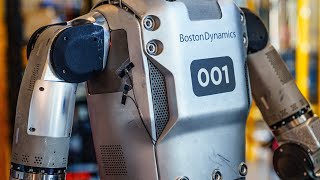
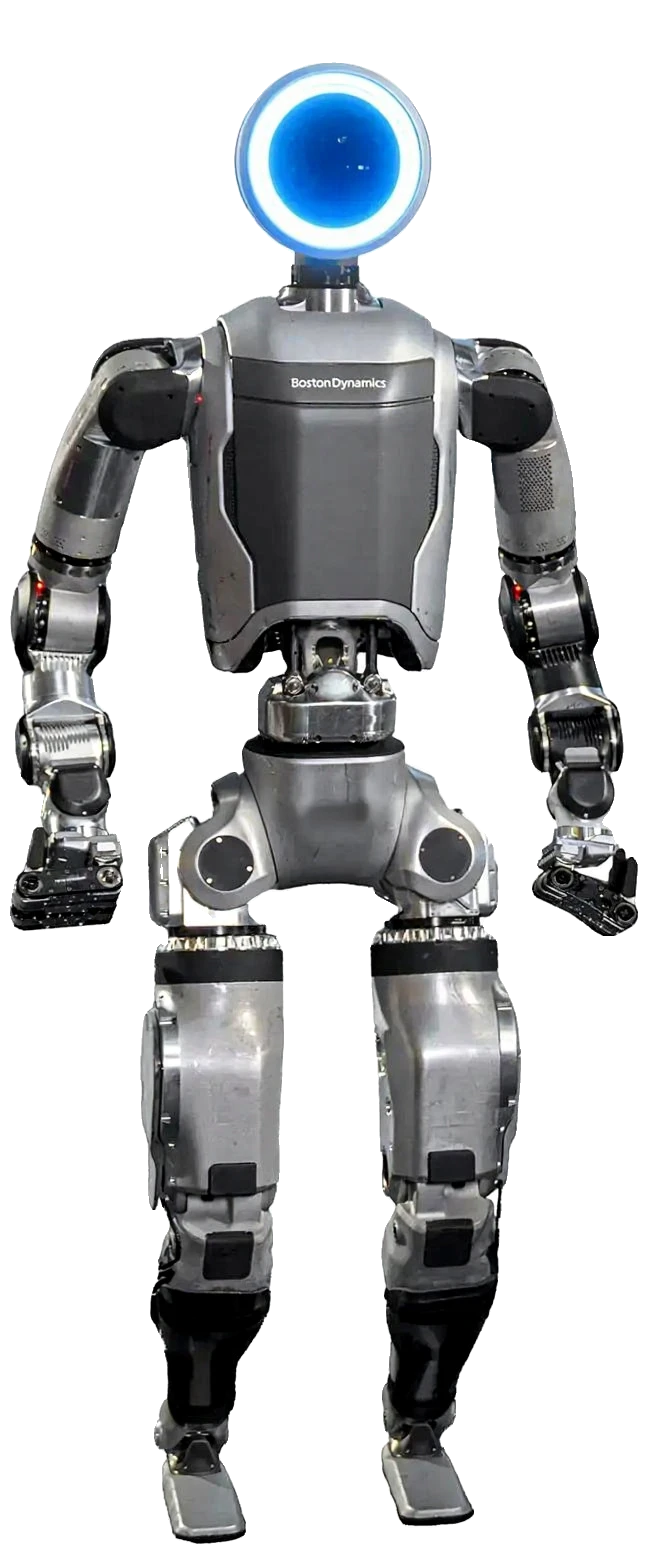
Atlas is an advanced humanoid robot developed by Boston Dynamics, a leading robotics company based in the United States. First unveiled in 2013, Atlas has undergone several iterations, with each new version pushing the boundaries of robotic capabilities.

Description

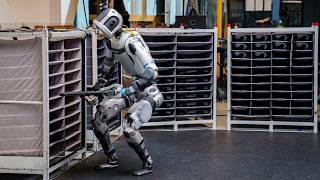
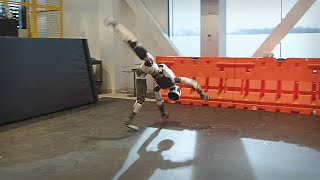
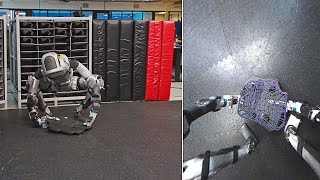
Atlas, developed by Boston Dynamics, represents the pinnacle of humanoid robotics research, evolving from its 2013 hydraulic prototype funded by DARPA for disaster response to a fully electric platform unveiled in April 2024. The latest iteration shifts from cumbersome hydraulics to efficient electric actuators, enabling real-world commercial applications, particularly in manufacturing. Standing at approximately 150 cm tall and weighing 89 kg, Atlas leverages a mixture of titanium and aluminum 3D-printed parts for an exceptional strength-to-weight ratio, allowing it to lift payloads up to 18-25 kg and achieve speeds of 2.5 m/s (9 km/h). Its architecture features around 28-50 degrees of freedom (DoF), with full-body configurations offering 50 DoF for locomotion and manipulation, and a Manipulation Test Stand (MTS) variant with 29 DoF focused on upper-body tasks. At the core of Atlas's capabilities is its advanced control system, integrating model predictive control (MPC) for balance and precise motion planning with reinforcement learning (RL) policies. Recent advancements include Large Behavior Models (LBMs), a 450 million parameter Diffusion Transformer architecture developed in collaboration with Toyota Research Institute (TRI). These end-to-end, language-conditioned policies operate at 30 Hz, processing head-mounted monocular camera images, proprioceptive joint encoder data, and natural language prompts to output action chunks for grippers, neck, torso, hands, and feet. Trained via iterative data collection from teleoperation (using VR interfaces and MPC), simulation, and flow-matching objectives, LBMs enable long-horizon tasks like picking, carrying, placing heavy irregular objects (e.g., 22 lb tires), folding robot legs, and navigating workshops while avoiding obstacles and self-collisions. Perception is powered by state-of-the-art vision models: lightweight 2D object detectors for bounding boxes and keypoints, fixture localization fusing 2D keypoints with 3D priors and odometry, and the SuperTracker for 6-DoF pose estimation using render-and-compare on synthetic CAD data. This system handles occlusions, shiny surfaces, and dynamic environments, fused with kinematic and force data for robust state estimation. Hand-eye calibration ensures centimeter-precision manipulation. Deployment history spans research milestones—parkour, backflips, dancing—to practical demos like autonomous engine cover handling. By late 2025, Atlas is in pilot testing with Hyundai for automotive factories, focusing on dull, dirty, dangerous tasks. Integration with Orbit fleet management software supports scaled operations. While still a prototype (not commercially available), Atlas pushes embodied AI frontiers, demonstrating behaviors exceeding human limits in agility and dexterity, with ongoing RL fine-tuning and VLM integration for broader generalization.

Key Features

Whole-Body Mobility and Manipulation

Atlas employs reinforcement learning and MPC for dynamic whole-body control, enabling parkour-level agility, squatting, wide stances, and bimanual handling of heavy, irregular objects exceeding human range of motion.

Advanced Perception System

Head-mounted cameras with 2D detection, keypoint localization, and SuperTracker pose estimation provide real-time 6-DoF object tracking, obstacle avoidance, and adaptation to factory environments.

Large Behavior Models (LBM)

450M parameter Diffusion Transformer policies, language-conditioned and end-to-end, execute complex multi-step tasks from natural language prompts at 30 Hz inference speed.

Electric Actuation and Lightweight Design

Fully electric actuators with custom high-power battery, titanium/aluminum 3D-printed frame deliver 220 Nm/kg torque density and 3+ hour runtime.

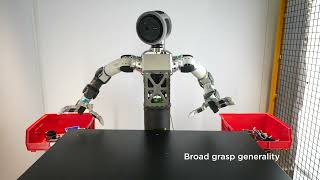
Dexterous Grippers

7 DoF per hand grippers support varied grasp strategies for rigid, deformable, and articulated objects, integrated with precise force feedback.

Specifications

AvailabilityPrototype
NationalityUS
Websitehttps://bostondynamics.com/atlas/
Degrees Of Freedom, Overall50
Height [Cm]150
Manipulation Performance3
Navigation Performance3
Max Speed (Km/H)9
Strength [Kg]18
Weight [Kg]89
Runtime Pr Charge (Hours)3
H.G Skill Score6
VerifiedNot verified
Walking Speed [Km/H]6
ManufacturerBoston Dynamics
Height Cm150
Weight Kg89
Dof Overall50 (full body); 28-29 (variants)
Dof Hands7 per gripper
Max Speed Kmh9
Payload Kg18-25
Runtime Hours3
MaterialsTitanium and aluminum 3D-printed parts
ActuatorsFully electric custom high-power
SensorsHead-mounted monocular cameras, joint encoders, force/torque (optional)
Perception2D object detection, keypoint localization, SuperTracker 6-DoF pose estimation
ProcessorsOnboard compute for 30 Hz RL policies (specific GPU/CPU N/A)
BatteryCustom high-output, electric (kWh/voltage N/A)
ControlModel Predictive Control (MPC), Large Behavior Models (450M param Diffusion Transformer)
Torque Density220 Nm/kg

Curated Videos

Video 1
Video 2
Video 3
Video 4
Video 5

Frequently Asked Questions

What is the difference between the old hydraulic Atlas and the new electric version?

The hydraulic Atlas (pre-2024) was bulkier with maintenance-intensive pumps, while the electric version is lighter (89 kg), more agile, dexterous, and efficient, using custom actuators for commercial viability without hydraulic mess, enabling broader real-world deployment like factory tasks.

What AI technologies power Atlas's behaviors?

Atlas uses Large Behavior Models (450M param Diffusion Transformers), RL policies, and MPC. Language-conditioned end-to-end networks process vision and proprioception for autonomous long-horizon manipulation and locomotion, trained iteratively on teleop and sim data.

What are the main sensors on Atlas?

Head-mounted monocular cameras for vision, joint encoders for proprioception, and optional force/torque sensors. Perception fuses these with ML models for 2D/3D detection, pose estimation, and kinematic odometry, enabling robust environmental understanding.

Is Atlas commercially available, and where is it deployed?

Atlas remains a research prototype as of 2025, not for sale. It's in pilot testing with partners like Hyundai for automotive manufacturing, focusing on unstructured tasks, with plans for scaled fleet integration via Orbit software.

What are Atlas's performance specs like speed and payload?

Top speed reaches 2.5 m/s (9 km/h), payload around 18-25 kg, height 150 cm, weight 89 kg, runtime 3 hours per charge. It excels in dynamic feats like backflips and precise placement within centimeters.

×