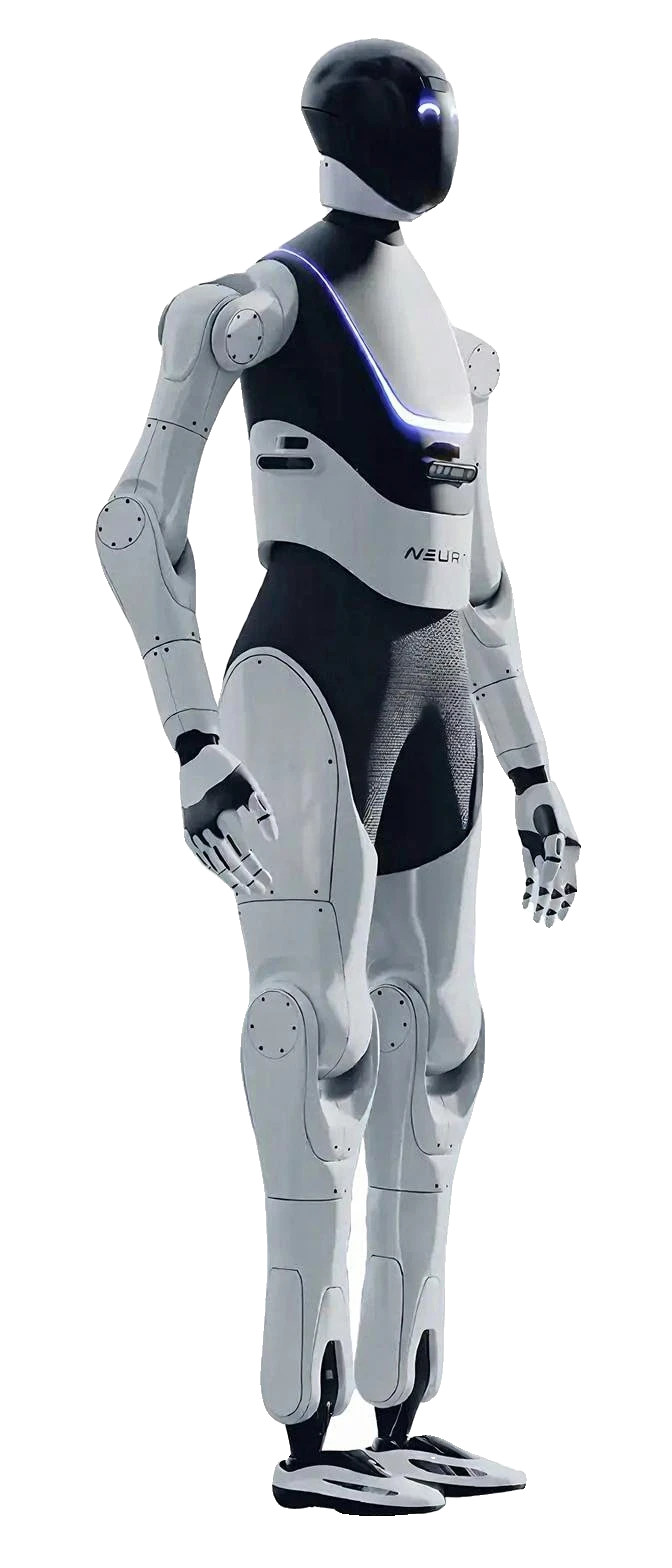
4NE-1
NEURA Robotics

4NE-1

The 4NE-1 humanoid robot by NEURA Robotics excels in cognitive robotics with advanced AI and adaptable capabilities for industrial and domestic applications. Its strength, mobility, and customizability make it a versatile tool for various environments.

Description

The 4NE-1 humanoid robot, developed by NEURA Robotics, a German company founded in 2019, represents a significant advancement in cognitive robotics, particularly with its third-generation model unveiled at Automatica 2025. Standing at 180 cm tall and weighing 80 kg, 4NE-1 is designed for both industrial and domestic applications, embodying the company's AURA AI platform and the Neuraverse ecosystem. Its architecture emphasizes human-like fluidity in movement, precise environmental perception, and seamless collaboration with humans, enabled by full-body sensing, adaptive control, and safe interaction protocols. At the core of 4NE-1's intelligence is the multimodal AURA AI system, which integrates computer vision, language models, reinforcement learning (RL), and sensor fusion. This allows the robot to perceive its surroundings via 360° perception using seven cameras, LIDAR, and microphones in the patented Omnisensor technology, distinguishing humans from objects and adapting behaviors accordingly. The robot features 'sensor skin'—a spray-on capacitive touch sensor covering hands, arms, and torso—that detects proximity, touch, and force intensity, enabling emotionally intelligent interactions and preventing collisions. Reports indicate a three-tier AI stack: small 5-6 million parameter models for rapid reflexes in limbs, a 500 million parameter model in the chest for local processing, and a 10 billion parameter cloud-based model for complex reasoning, powered by NVIDIA partnerships including Isaac Sim, Isaac Lab, and GR00T N1. Mechanically, 4NE-1 boasts powerful joint technology for lifting up to 100 kg with legs (220 lbs) and 10-15 kg with hands, speeds up to 5 km/h, and 25 degrees of freedom overall. It supports exchangeable forearms, a 7th axis for extended reach, wheeled variants for industrial floors, and hot-swappable dual batteries for 24/7 operation. Fine-motor hands are learning-capable for dexterous tasks. The Neuraverse platform acts as an app store for skills, allowing over-the-air updates for welding, assembly, cleaning, or cooking via developer contributions. Deployment history includes prototypes since 2022, with Gen 3 production-ready claims for 2025 shipments. Pilots target logistics, manufacturing, healthcare, and homes, backed by €120M Series B funding and partnerships with NVIDIA, SAP, Omron, Schaeffler, and HD Hyundai. NEURA's 'NEURA Hive' automated assembly enables scalable production. Despite no live demo at Automatica due to logistics, 4NE-1 positions Europe in the humanoid race, aiming for 5 million units by 2030 amid €1B order backlog rumors. Real-world tests in NEURA Gyms use physical AI training for robustness. Challenges remain in full autonomy, but its sensor fusion and cognitive stack promise versatile, safe humanoids for labor shortages.

Key Features

360° Perception & Omnisensor

Integrates seven cameras, LIDAR, and microphones for full environmental awareness, distinguishing humans from objects and enabling safe navigation in unstructured spaces.

Sensor Skin Technology

Spray-on capacitive sensors detect proximity, touch, and force across body, allowing precise, safe human-robot interactions with emotional intelligence.

AURA AI & Multimodal Processing

Proprietary AI with computer vision, language models, RL; three-tier stack (edge, local, cloud) for reflexes, perception, and reasoning, NVIDIA-powered.

Neuraverse Ecosystem

App store for robot skills, OTA updates, developer marketplace for tasks like assembly or household chores, turning robots into upgradeable assets.

High Payload & Dexterity

Lifts 100kg legs/10kg hands, exchangeable forearms, fine-motor hands; speeds 5 km/h, DoF 25, for industrial and domestic versatility.

24/7 Operation

Hot-swappable dual batteries, robust joints, IP-rated for continuous use in factories or homes.

Specifications

AvailabilityPrototype
NationalityGermany
Websitehttp://N/A
Degrees Of Freedom, Overall25
Height [Cm]180
Manipulation Performance2
Navigation Performance2
Max Speed (Km/H)4
Strength [Kg]15
Weight [Kg]80
Runtime Pr Charge (Hours)2
Connectivity5G via Vodafone, Neuraverse OTA
H.G Skill Score4
VerifiedNot verified
Walking Speed [Km/H]3
ManufacturerNEURA Robotics
Height180 cm
Weight80 kg
Payload10-100 kg (legs: 100 kg, hands: 10-15 kg)
Max Speed5 km/h
Degrees Of Freedom25 overall
SensorsOmnisensor (7 cameras, LIDAR, microphone array), capacitive sensor skin (proximity, touch, force), force-torque sensors, 3D vision for object/gesture recognition
ProcessorsNVIDIA Jetson onboard, cloud integration with 10B param models
AiAURA multimodal AI, RL, LLM, computer vision; 3-tier: 5-6M/500M/10B params
BatteryDual hot-swappable, ~2 hours per charge, 24/7 capable
Motors/GearsPowerful joint actuators, fine-motor hands
MaterialsRobust composites with spray-on sensor skin
Ingress ProtectionIP66 rated components
OtherExchangeable forearms, wheeled/7th axis variants, backflip capable

Curated Videos

Video 1
Video 2
Video 3
Video 4

Frequently Asked Questions

What is the lifting capacity of 4NE-1?

The 4NE-1 can lift up to 100 kg using its legs and 10-15 kg with its hands, thanks to powerful joint technology and fine-motor capabilities, making it suitable for heavy industrial loads while handling delicate objects safely.

How does the sensor skin work?

The artificial sensor skin uses capacitive technology sprayed onto surfaces like hands and torso, detecting proximity before contact, touch intensity, and force, enabling proactive collision avoidance and nuanced human interactions beyond traditional force-torque sensors.

What AI models power 4NE-1?

Powered by AURA AI with a three-tier system: 5-6M param edge models for quick reactions, 500M param chest unit for environment processing, and 10B param cloud model for complex tasks, integrated with NVIDIA GR00T and Isaac platforms via Neuraverse.

Is 4NE-1 production-ready?

Yes, the third-generation model is claimed production-ready with first shipments in 2025, supported by NEURA Hive automated assembly, €120M funding, and partnerships; pilots ongoing in logistics and manufacturing.

What applications suit 4NE-1?

Versatile for industrial workflows (logistics, assembly), healthcare (patient assistance), retail service, and home tasks (cleaning, carrying); customizable via Neuraverse skills for specific environments.

How long does the battery last?

Features a dual hot-swappable battery system for 24/7 continuous operation, with runtime per charge around 2 hours based on early specs, optimized for industrial uptime.

×